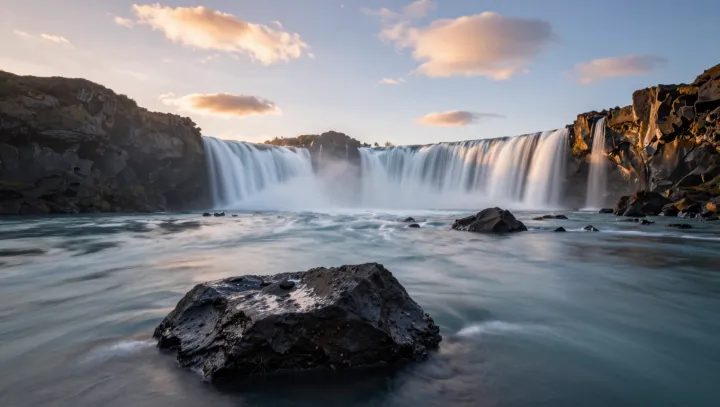
Smooth water is a lie. At the brink, a river that appears to arrive as one polished mass is divided by grooves, ribs, and shallow notches in bedrock, each steering part of the discharge into a separate sheet before the fall has properly begun. The split starts upstream.
The lip is the true author. Its hydraulic roughness interrupts free-surface flow: small rises concentrate water, while depressions let thinner streams peel away, and a boundary layer slows fluid nearest the rock even as faster water slides above it. Order survives briefly. What looks like a single waterfall is often a bundle of channels sharing the same edge.
Gravity finishes the argument. Once unsupported, each sheet accelerates, stretches, and thins; uneven ledges deflect it again, producing gaps, ribbons, and veils whose edges are held together only partly by surface tension. Air resistance adds a restless tug. The result is not softness but mechanics made visible: water keeps falling, while stone quietly dictates the shape of its surrender.