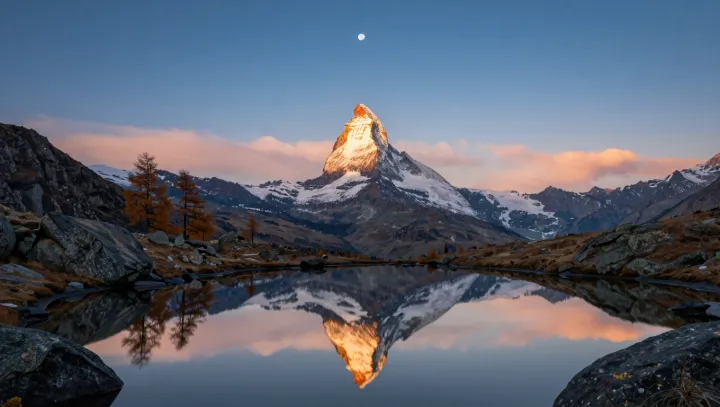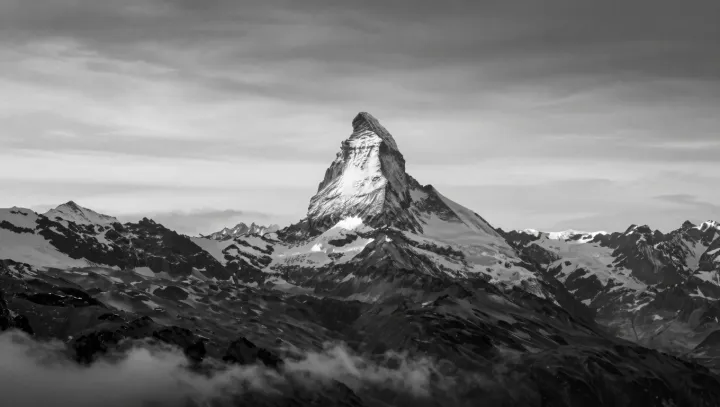
The summit is lying, beautifully. When a low cloud bank swallows a mountain's feet, the exposed crest seems to rise from nowhere, while its boundary cuts against a pale moving screen. Scale vanishes first. What remains is not more mountain, but a more forceful visual claim: a peak detached from the ordinary measurements of slope, road, and tree.
This is less weather magic than perceptual bookkeeping. The eye economizes ruthlessly. Occlusion strips away the lower contour and with it the familiar scale markers--trees, ledges, roads--that let size constancy do its quiet work. A summit, framed by cloud rather than adjacent ridges, becomes a figure against a simplified ground. Simultaneous contrast can then make its rim appear cleaner, especially when dim rock meets a brighter cloud field. The cloud adds no altitude. It deletes objections.
The stronger illusion is emotional. Depth gets edited. Aerial perspective normally grades distance through haze and declining contrast; a cloud deck interrupts that gradient, leaving no visible route from valley to summit. The mind supplies the concealed mass, yet gives its attention to the exposed upper rock, which now resembles an island above a blank sea. Nothing has grown. But with the foothills erased, the summit seems to have escaped the earth that made it.