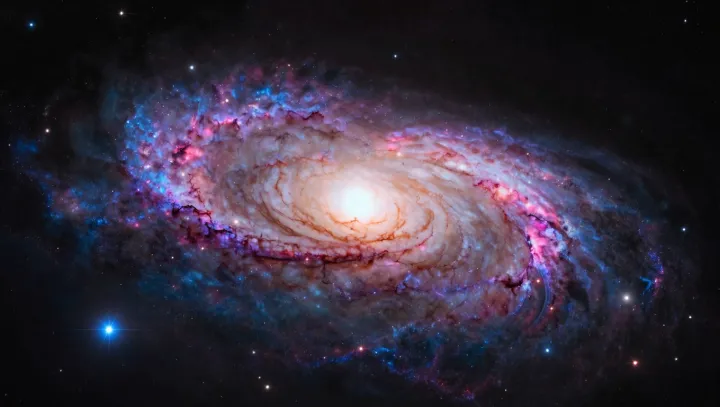
The bright spiral lies. Across a dark galactic disk, blue-white knots flare beside lanes of dust and gas, suggesting a stellar pinwheel locked in place. It is not. The arms are density waves: moving zones of crowding through which stars and gas travel, then depart.
Calling the arms structures gets the physics backward. Their pattern rotates at a pattern speed that differs from the orbital velocity of much of the disk, while differential rotation carries stars across the arm rather than fastening them to it. Gas pays the toll. As it enters the crowded zone, gravitational perturbation and compression can form shock fronts, raising density until cold molecular clouds collapse under gravity.
The result is not merely decorative. New stars ignite inside or near these compressed lanes, and their short-lived blue light outlines the arm with a brilliance older stars cannot match. Then they move on. What seems like a permanent celestial drawing is closer to a recurring bottleneck, where matter gathers, burns, and slips back into the dark.