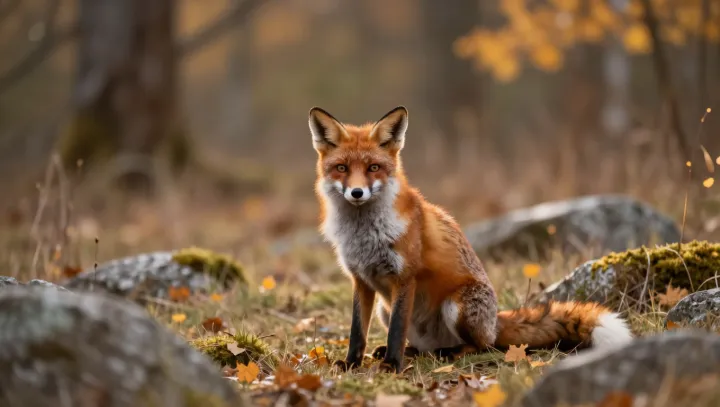
Copper fur is a better disguise than the cartoon version of a fox suggests. Beneath slanting autumn light, orange hairs borrow the color of leaf litter while darker guard hairs echo bark and shadow. Then it vanishes. What reads as flamboyance in a field can become concealment among trunks.
This is not magic, but it is more exact than the usual story of a bright animal in hiding. Camouflage works through background matching: the coat's spectral reflectance sits amid the rusts, browns, and golds thrown back by dead leaves, weathered wood, and sunlit soil. Contrast matters. Low-angle light breaks across uneven ground, so the fox's outline loses the clean edge that a watcher needs; disruptive coloration, supplied by black legs, ears, and shadowed fur, further interrupts that silhouette. That judgment also depends on the viewer: camouflage is not a property of fur alone, but an interaction between illumination, surface texture, distance, and the visual system doing the search. At close range, the animal remains visible; at a distance, the forest's clutter begins to do the work. The trick is conditional. On snow, open grass, or against a plain wall, the same red coat announces its owner; in deciduous cover, it is a bargain struck between pigment and place. Movement still ruins the bargain. Yet when the animal pauses, the eye must sort a coat from a crowded field of small, warm-colored signals. A fox need not become the forest. For a moment, the forest merely agrees to misread it.