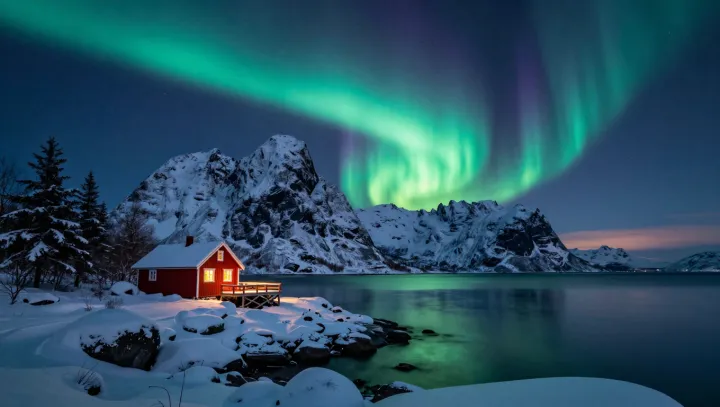
The fjord gets credit. Green bands shiver on black ice, while violet fringes slide behind them as if the sky had dropped a curtain into the water. That is an illusion. You are watching light made far above the clouds, where charged particles arrive from space and meet thin gas.
The curtain is physics. At high altitude, excited oxygen releases green photons after electrons transfer energy in collisions, a process shaped by low air density. Oxygen owns the green. Lower down, ionized nitrogen can emit violet and blue-violet light, because denser air changes how often particles collide and how quickly they lose energy. Magnetism sets the route. The solar wind can disturb Earth's magnetosphere, which funnels charged particles toward polar regions along magnetic field lines instead of letting them fall randomly.
Reflection is the trick. Water and ice do not bring the aurora down; they mirror and scatter its photons, stretching moving bands across a fjord's dark surface. Your eye completes it. Against a dim horizon, the contrast between black water and luminous sky can make a distant emission seem close enough to touch. That is the seduction. Would you still call it a curtain once you knew the fabric was oxygen, nitrogen, electron excitation, and a restless solar wind?