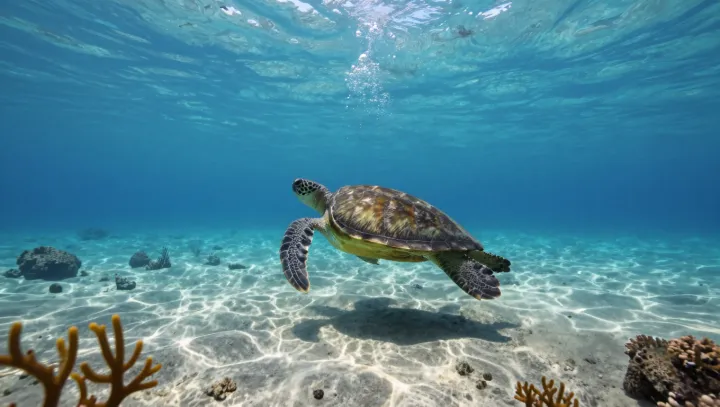
Pressure does the clever work. As a sea turtle descends, hydrostatic pressure squeezes the gas in its lungs, shrinking pulmonary volume; when it climbs, that gas re-expands and restores lift. No motor required. The animal turns compression into a built-in buoyancy control system rather than spending muscular effort to hold depth.
This is better than batteries. Under Boyle's law, gas volume falls as ambient pressure rises, reducing positive buoyancy and helping the turtle avoid fighting its own flotation with every stroke. No trick is involved. Think dynamic memory allocation: pulmonary gas volume contracts under hydrostatic pressure, then returns during ascent, as though the body were reallocating lift rather than burning fuel to manufacture it. The math is physical. Less gas volume means less displacement and therefore less upward force, described by Archimedes' principle.
The savings are real. Diving is not merely a trip downward; it is a balancing act among buoyancy, oxygen stores, and locomotor cost, with lung compression lowering the work needed to stay submerged while also changing gas-exchange conditions. Biology wrote the firmware. Engineers studying underwater vehicles and soft robotics can draw a useful lesson: let hydrostatic pressure reshape a system's state, and machines may carry less active control hardware into the deep. Passive mechanics could become mission endurance, where every spared watt extends range, sensing, and survival.