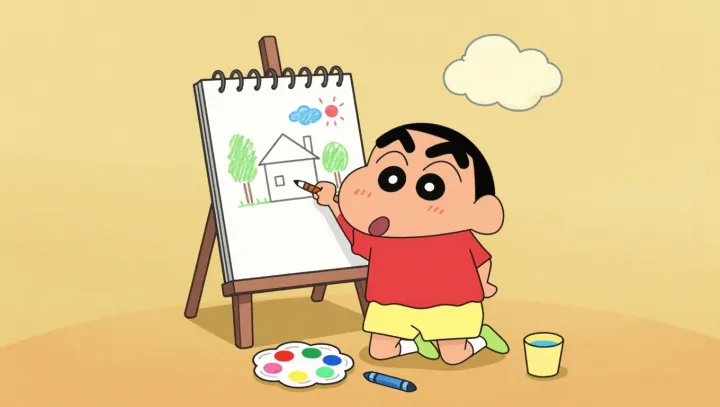
Yellow hits first. On a child's paper house, that loud patch is not mere decoration: it asks the eyes to separate one hue from nearby marks while the hand keeps a crayon inside a changing border. A feedback loop starts. Each chosen color records attention, taste, and a decision that has to survive motion.
This is serious play. Color selection can recruit visual attention and color discrimination, then call on inhibition when a child resists the tempting red crayon. Pause before choosing. That pause lets preference become behavior rather than accident, while working memory holds the intended color and the outline at once. No score is needed. Repeated choices give practice in self-monitoring because the child can see whether the hand followed the plan.
Hand-eye control sets terms. Visuomotor integration, the coupling of visual input with purposeful hand movement, acts like a tiny rendering engine: the eye supplies coordinates, the wrist executes them, and each missed edge returns an error signal. Small corrections count. The scientific name remains visuomotor integration, with fine-motor control and proprioception shaping each response. A plain house can exercise feedback loops used in writing, cutting, and deliberate marks. That is the extrapolation: learning tools that preserve this loop could respond to a child's attention without taking away the child's authorship.