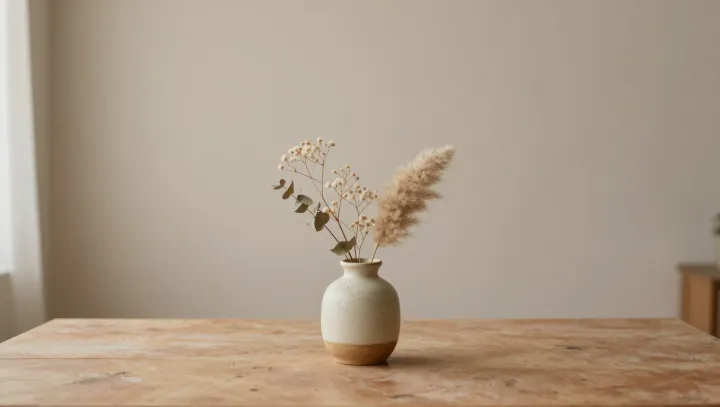
Roughness offers mercy. Across a matte clay surface, light breaks into diffuse reflection rather than assembling itself into sharp specular highlights, so the eye meets a low-glare field before it inventories the stems, papery petals, and curled edges above it. The contrast loosens. Nothing needs polishing.
The effect is perceptual, not sentimental. Because visual perception judges form against its immediate surround, simultaneous contrast can make an object seem harsher when it is framed by a sleek, bright plane, where every brittle silhouette receives a hard edge. Scale matters too. A vessel's microtexture gives the eye many small irregularities to read, reducing the dominance of any single thin stem. Texture changes the hierarchy. Instead of treating each bloom as a lone, breakable signal, the eye distributes attention across adjacent surfaces, producing a gentler impression without changing the flowers at all.
The pairing is quietly strategic. A glossy vessel tends to stage dried botanicals as specimens, since its specular reflection repeats outlines and concentrates luminance contrast around thin stalks. Matte clay declines that contest. Its porous-looking surface suggests handling, weather, and slow making, while the flowers borrow that visual register: not stronger, not less breakable, but less isolated in the still frame. The vase does less. In that restraint, brittleness becomes hush.