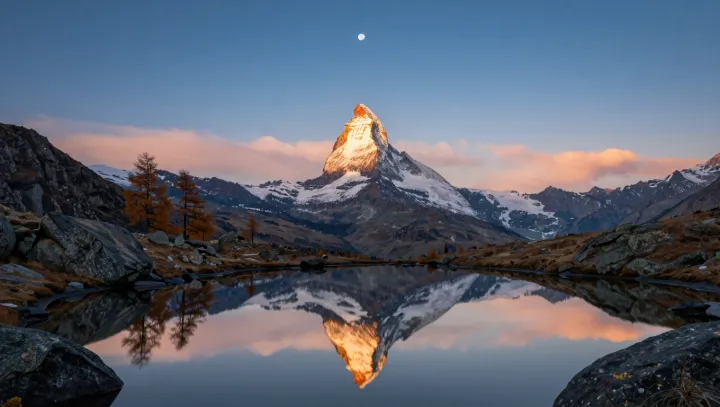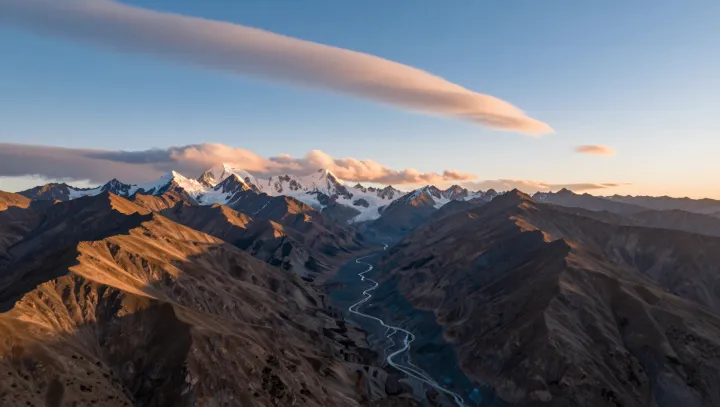
Clouds catch fire first. As the Sun drops behind a mountain ridge, rays still reach cloud decks high above it, while the ground has crossed the terminator, the moving boundary between direct illumination and night. Height decides the scene. A high cirrus sheet may remain sunlit even when low stratus and every slope have gone dark. Not sentiment, but geometry, creates the split scene: peach overhead, blue below.
The peach is selective. Near sunset, sunlight travels a far longer atmospheric path, so Rayleigh scattering removes much of the shorter blue and violet light before the beam reaches the clouds. The filter is brutal. What remains is enriched in red, orange, and yellow wavelengths, which cloud droplets and ice crystals redirect through Mie scattering toward the eye. Aerosol optical depth can deepen the effect, although heavy haze may mute it by scattering and absorbing the remaining beam. Thin clouds win.
Blue shadow is no failure. A mountain loses direct solar irradiance the instant a ridge blocks the Sun, yet its slopes still receive diffuse skylight, whose blue bias is built by Rayleigh scattering across the open sky. Dark surfaces drink it. Rock, soil, and forest absorb much of that weak illumination, leaving diffuse blue as the main visible wash. The contrast is merciless. The eye reads neighboring colors as more intense because simultaneous contrast sharpens their divide. Clouds, higher and still exposed to the reddened beam, retain daylight after valleys enter geometric shadow. The sky keeps the richer ledger, while the ground pays night its first installment.