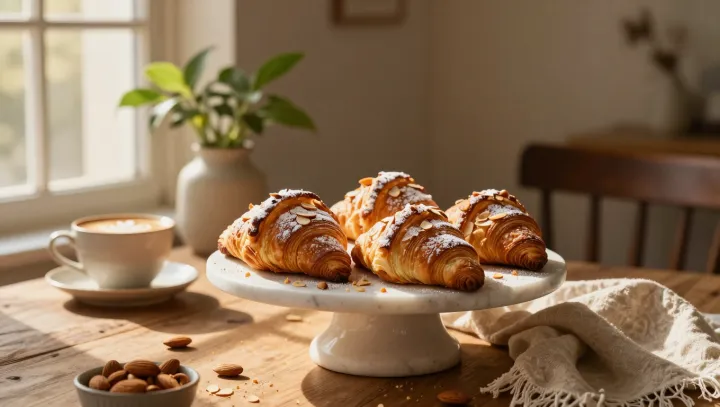
Air is the luxury. A fractured almond croissant scatters flakes because its laminated dough was built as a stack of flour-and-water layers divided by butter, then folded repeatedly until the interior held thousands of thin boundaries. In the oven, butter melts, water flashes into steam, and those boundaries separate. The bite feels rich before it feels filling.
This is engineering. Much of the pastry's volume is void space, yet the voids intensify pleasure because crisp walls fracture under low force and release butter aroma quickly, while almond cream supplies fat, sugar, and a moist counterweight. Fermentation supplies carbon dioxide before baking. Steam leavening expands the cells more forcefully, while gluten coagulation and starch gelatinization firm their walls before cooling can pull them closed. More surface area also gives heat more places to dry dough into a brittle shell.
Crunch makes richness legible. The Maillard reaction browns exposed layers and adds roasted notes, while sugar in the filling attracts water and softens selected pockets, so each shatter feels less dry than a plain croissant. The contrast is deliberate. A dense cake can deliver similar ingredients with fewer audible fractures, less aroma release, and none of the visual promise created by lifted sheets. Here, absence does not read as lack; it reads as effort, held briefly between the fingers.