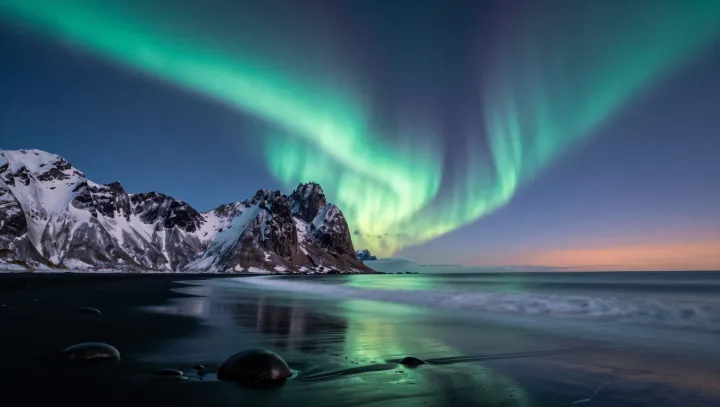
Above the white ridges, the green band is not a stain on the night but a timed atomic release, occurring in the upper mesosphere and lower thermosphere, where oxygen can hold an excited state long enough to speak in light. The mountains only frame it.
Atoms conceal the drama. Electrons, accelerated along magnetic field lines after solar-wind disturbances load energy into the magnetosphere, collide with rarefied air and cause collisional excitation in atomic oxygen. Then comes the telltale drop. An atom falling from its metastable 1S state emits the 557.7-nanometer green line, a narrow spectral signature rather than a broad atmospheric glow. It is not a lamp. It is a statistical outcome of radiative decay competing with collisional de-excitation, made conspicuous by a wavelength to which human vision responds strongly.
Altitude decides color. Near one hundred kilometers, gas is thin enough that an excited atom generally radiates before a collision can quench it, yet dense enough to offer plentiful oxygen and impacts from incoming electrons. Below, collisions win. At greater heights, oxygen grows sparse, while its longer-lived metastable 1D state can produce the red 630.0-nanometer line under conditions that deny green its advantage. That balance is unforgiving. A modest density shift changes the odds between radiative decay and collisional de-excitation, allowing one transition to finish while another is interrupted. Snow stays silent; atoms answer.