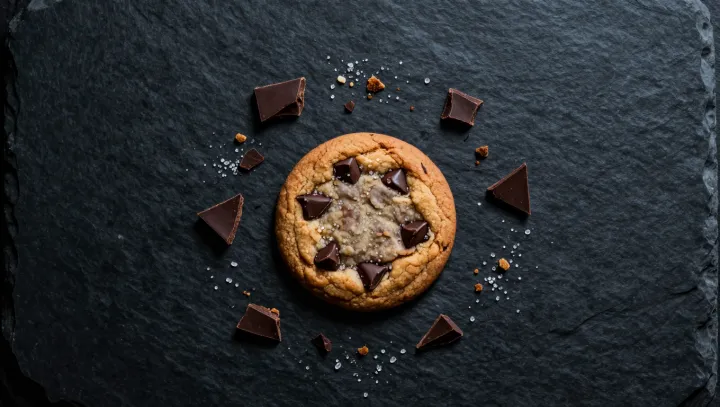
The edge wins first. Where dough meets the hot pan, conductive heat transfer drives water toward evaporation, and its thin cross-section loses moisture before the middle can respond. A dry rim sets. Meanwhile, the thicker center holds more water and has less exposed surface per bite, so its temperature and water activity shift at a slower pace, preserving tenderness.
This is deliberate. At the perimeter, escaping water lowers water activity as starch gelatinization and protein coagulation build a firm matrix; concentrated sugars then support Maillard reactions and deepen browning. Structure arrives early. In the middle, distance from the surface limits evaporation, while surrounding dough buffers heat, delays the rise of solids, and leaves enough moisture to prevent the same brittle set. That lag matters. The center retains a pliable crumb because water plasticizes the starch-protein network even after the outer ring has become crisp.
Unevenness is the product. Think of the oven as a thermal compiler: heat diffusion, the scientific process moving energy through dough, lets the edge execute first because its route to the surface is shorter and its mass is smaller. Thickness becomes a dial. Add central mass and moisture takes longer to escape, widening the gap between snap and chew; flatten the dough, and that gap contracts. That is controllable. With thermal imaging and model-based recipes, bakeries could tune moisture gradients batch by batch, making texture an engineered output rather than a lucky accident.