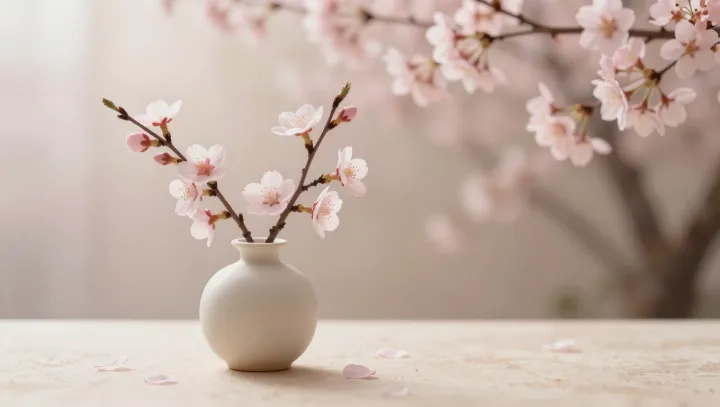
The illusion is backwards. Pale petals do not carry pink as hidden cargo; as sunlight meets pigment-bearing epidermal cells, selected wavelengths are removed, and the light left for an eye to register tilts toward red. They look almost absent. Yet their color is a calculation.
That correction matters. Anthocyanins, often stored in cellular vacuoles, act as chromophores: molecular structures whose electrons absorb photons at particular energies. Blue and green portions of incoming light are commonly diminished, while red-rich wavelengths are reflected or transmitted. No pink reservoir exists. What the eye calls pink is the remnant after selective absorption, softened by low pigment concentration and the petal's thin tissue.
The flower's trick is optical, not ornamental. Vacuolar pH can alter anthocyanin absorption, while cell shape, air spaces, and internal scattering spread the surviving light into a paler signal. Physics does the painting. A petal may seem lighter than breath, yet it holds a strict molecular argument against the idea that color is a substance waiting inside.