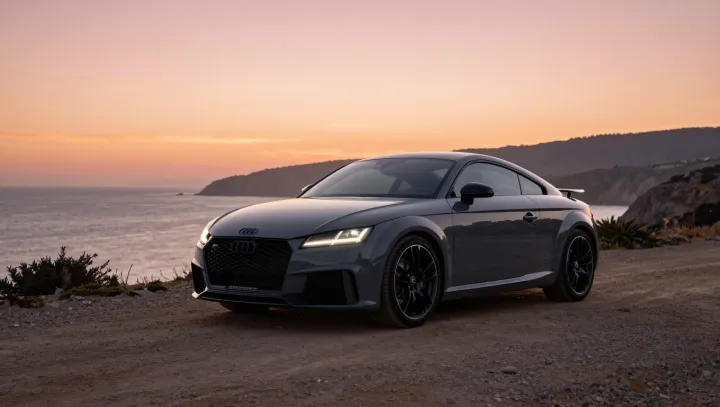
Sunset lights the wing. It is not decoration. In a fast corner, air moving across its cambered profiles creates a pressure differential that can load the rear tires with more downforce than the car's gravitational weight. Color lies. Physics does not.
The trick is accounting. Through circulation, angle of attack, and boundary-layer control, the wing turns airflow downward and keeps it attached, producing lower pressure above than below. That load buys grip. In computational fluid dynamics, it resembles a graphics processor allocating bandwidth: air parcels are redirected with ruthless efficiency, and the rear tires receive the resulting normal force. Induced drag collects payment on every straight, so wing design is a trade between cornering authority and terminal speed.
This changes the machine. When aerodynamic load overtakes static weight, the rear axle gains normal force without extra ballast, so cornering capacity rises until tire compound, suspension geometry, or disturbed airflow sets the limit. Speed is only the prize. Active aero can pair pressure maps, yaw rate, and actuator control in a closed feedback loop, turning a wing from fixed hardware into software-directed force. The limiting question moves beyond whether air can hold a car down; it becomes how precisely a control system can exploit that invisible surplus before drag, instability, and thermal wear demand repayment.