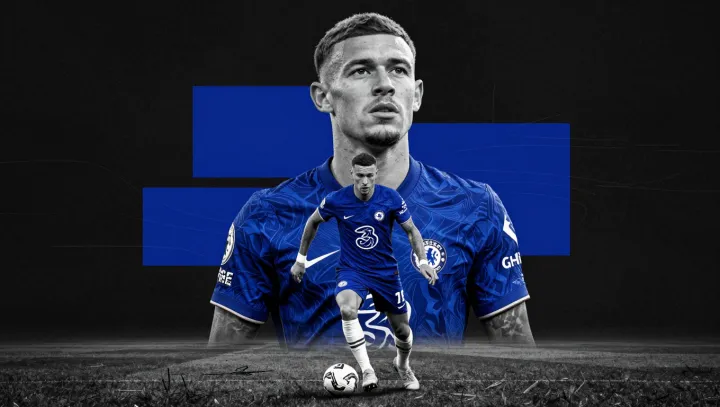
Blue and black win. In their collision, a routine dribble stops behaving like incidental game footage and starts making a claim: this is not merely motion, but authorship. Two images, one subject. The ball sits low, the stride breaks forward, and a paired portrait holds the face still, giving the eye two routes into one player.
The poster is smarter than it first appears. That is no accident. Contrast functions as visual hierarchy: the action frame carries kinesthetic information, while the portrait supplies recognition cues that a moving image can lose. Rather than asking viewers to decode the athlete after following the ball, the composition performs both tasks at once. It treats identity as a second play, running beside the dribble.
That economy matters. Noise is cheap. Sports graphics often mistake clutter for force, piling type, texture, and light effects onto a familiar pose until the player becomes decoration. Here, blue and black impose restraint, while the duplicated figure creates tension between speed and presence. One glance catches the move. Another catches the person. Between them, the game hangs briefly still.