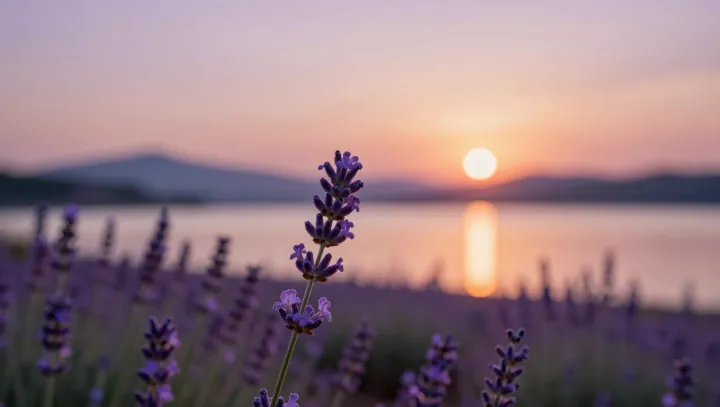
The purple is a decoy. Lavender's familiar calm begins not in its color but in volatile organic compounds that escape the flower surface, enter moving air, and reach the nose before the eye has finished admiring the bloom. Pigment stays put. Anthocyanins make petals purple; linalool and linalyl acetate evaporate from glandular trichomes and become airborne.
That distinction is routinely blurred. Scent is chemistry in motion, governed by vapor pressure, temperature, plant variety, and the bruising or warming of floral tissue; a vivid blossom can offer little aroma, while a pale sprig can perfume a room. The nose does not smell calm itself. It detects molecules, whose signals bind olfactory receptors and are relayed through neural circuits tied to memory and emotion. Even dried lavender retains fragrance only while enough volatile material remains to leave its tissues.
Lavender's reputation deserves skepticism, not dismissal. Laboratory and clinical work has examined lavender volatiles, especially linalool, for associations with reduced anxiety or altered arousal, yet results turn on dose, exposure route, expectation, and study design. Aroma is not magic. Inhalation differs from skin application, and a pleasant odor can shape attention before any measured physiological change appears. It is an atmospheric transaction: compounds leave plant tissue, cross a room, bind receptors, and acquire meaning in a brain already crowded with experience. The flower supplies the molecules; purple merely catches the light.