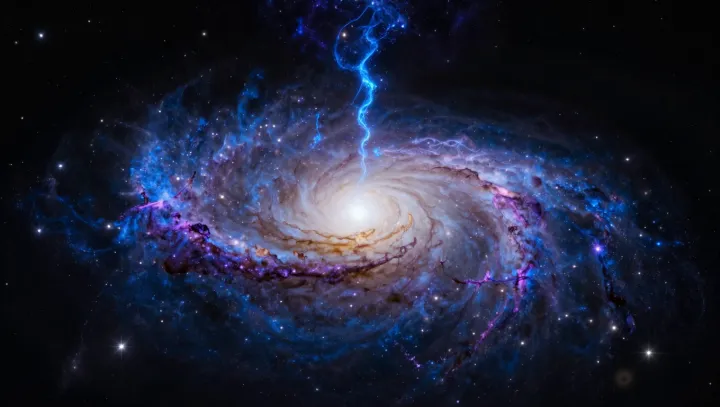
The blue arms are a trick of timing, not a permanent paint job. Along spiral density waves, gas is compressed into molecular clouds, where gravitational collapse ignites fresh star formation; massive stars burn hot, radiate blue light, and die before orbital motion carries them far from the arms. Their brilliance expires quickly.
The bulge tells a sterner story. Near a galaxy's center, much of the gas was converted into stars early or cleared by stellar feedback, while mergers and orbital mixing assembled a pressure-supported stellar population; cooler, lower-mass stars survive for far longer, giving the bulge its yellow or red cast after blue giants have disappeared. Age holds the center.
Yet the divide is never perfectly clean. Bars can drive gas inward and spark central star formation, while spiral arms contain older stars beneath their blue frosting; still, the usual color contrast records unequal clocks, with short-lived massive stars advertising current activity and durable small stars preserving an earlier chapter. A galaxy keeps its memory in light.