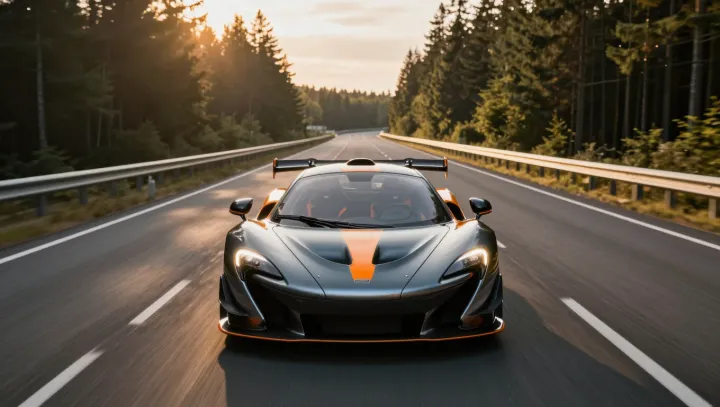
The low nose is a visual hack. Under showroom light, a sports car seems to be cutting through air because its front edge sits near the ground, while the windshield and roof pull the eye rearward in one unbroken sweep. Nothing moves. The visual system supplies velocity anyway.
That impression is efficient, not mystical. Predictive coding, a neural inference process, operates like a graphics processor preloading a racing scene: prior exposure teaches the brain to treat a low ride height, a stretched hood, and a tapering cabin as signals of speed. Optic flow normally confirms travel when patterns sweep across the retina, yet static form can trigger a weaker expectation of that flow. The dorsal visual stream helps turn proportion into an immediate guess. The effect is not deception by itself; it is perception doing fast, economical work.
Designers exploit that shortcut, and buyers often mistake it for evidence. A wide track and low center of gravity may support handling, but they do not establish it; power-to-weight ratio, tire compound, suspension kinematics, braking capacity, and aerodynamic downforce decide what happens after the light turns green. That gap between promise and lap time is where marketing earns its keep. Soon, neural rendering in digital configurators and mixed-reality displays may tune these cues with ruthless precision, making a parked silhouette feel faster than hardware can justify.