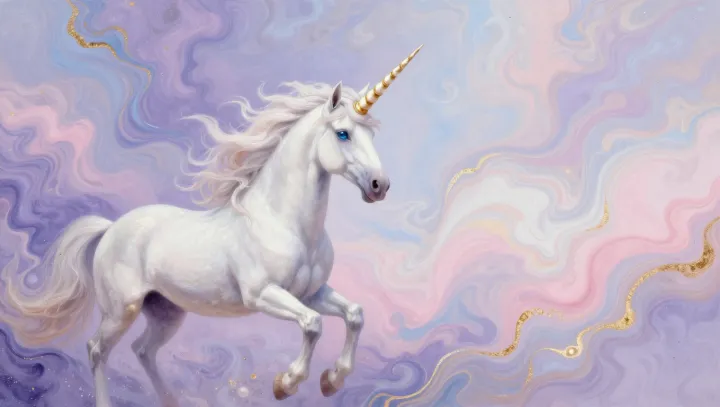
The swirl does the moving. Veins of color bend around a unicorn's horn and shoulder, then tighten into eddies, making the paper plane read less like a surface than a paused frame from a pour. Motion is inferred before it is seen.
This is not magic. The eye applies Gestalt continuity: it follows uninterrupted curved paths and assumes their direction persists beyond the instant shown. Marbling also carries cues from fluid dynamics, including shear, vorticity, and laminar stretching, whose marks resemble pigment dragged through a viscous medium. The unicorn gets caught inside that vector field. Where its contour aligns with streamlines, the brain gives the animal a trajectory, as though its body is displacing liquid rather than sitting on decoration.
Contrast seals the trick. In perceptual neuroscience, predictive coding makes vision operate like a motion-rendering engine: it uses partial evidence to forecast the most likely event. Figure-ground segregation pulls the pale creature forward, while occlusion cues let colored bands seem to pass behind its neck, legs, and mane. The frame stays still. Yet once image systems can tune those cues with precision, static art may feel less like a picture and more like a frozen simulation waiting to resume.