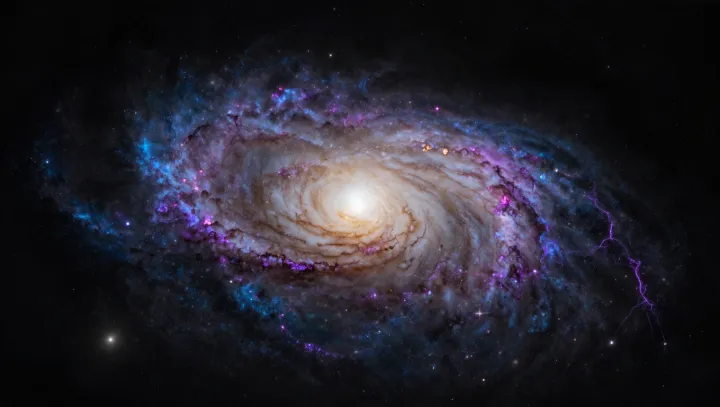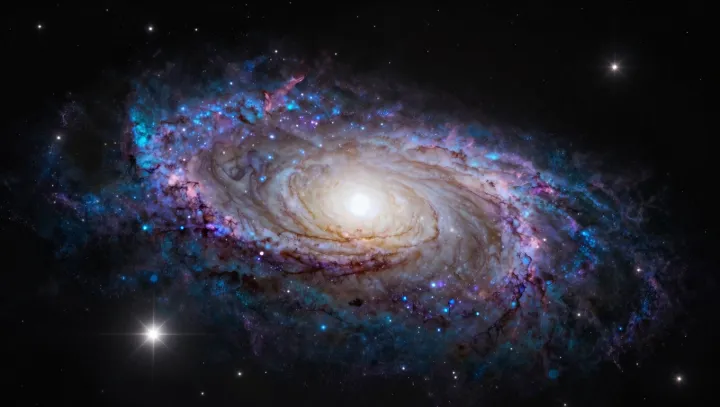
The blue-violet curve is a trick of traffic: against a dark disk, young stars mark a crowded lane whose location is governed by gravity, rather than a fixed population traveling together. Not a stellar river. As the disk rotates, material crosses the lane while its pattern can hold a recognizable shape across many rotations.
The prettier account fails. A spiral density wave, a region of enhanced mass density, perturbs the gravitational potential and makes gas bunch as it enters the arm; compression then promotes star formation. Blue light follows. Massive hot stars burn briefly, so their clustered glow outlines where gas was recently squeezed, while older stars continue through and fade into the disk. Differential rotation supplies the illusion of motion: inner orbits usually circulate faster than outer ones, yet a wave pattern can rotate at its own pattern speed. The speeds diverge. Near corotation resonance, the relation between orbital motion and that speed changes character.
Gravity writes no single script. A central bar or passing companion can impose a non-axisymmetric perturbation, organizing orbital responses into a long-lived pattern; in other disks, transient recurrent overdensities arise through self-gravity and swing amplification. The stars do not settle. Their epicyclic orbits carry them into and out of the overdensity, while gas can shock along the lane and produce fresh luminous markers. What seems like a painted whirl is a recurring argument between orbital order and matter that refuses to keep still.