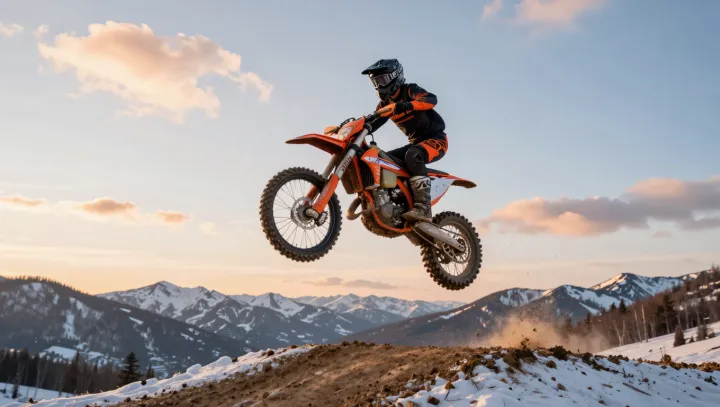
Snow releases the tires, and the argument is mostly over. Beneath the bike, the slope had supplied normal force and friction; those contact forces could redirect speed, brake it, or hold an edge. Once separation occurs, gravity assumes command, while aerodynamic drag offers only a thin, delayed objection.
The exit is nearly final. A bike and rider now behave as a projectile: the center of mass follows a ballistic trajectory set by launch position, velocity, and gravity. Steering no longer means much because the front tire has nothing to push against. Braking cannot pull the machine backward through air. Wind and drag can alter the path, but usually too slowly to rescue a bad takeoff. The snowy slope had been an active partner; airborne space is not. It is a harsh exchange. Contact gave the rider a menu of corrections, whereas flight reduces that menu to small adjustments in body position and attitude.
Skill still matters, though less romantically than riders may wish. By shifting mass or spinning a wheel, a rider can influence pitch through angular momentum and gyroscopic effects, helping match the bike to the landing angle. The arc remains stubborn. Such inputs reshape orientation, not the main forward course, because no external horizontal force appears on demand. In midair, freedom can look like control. It is usually only preparation for impact.