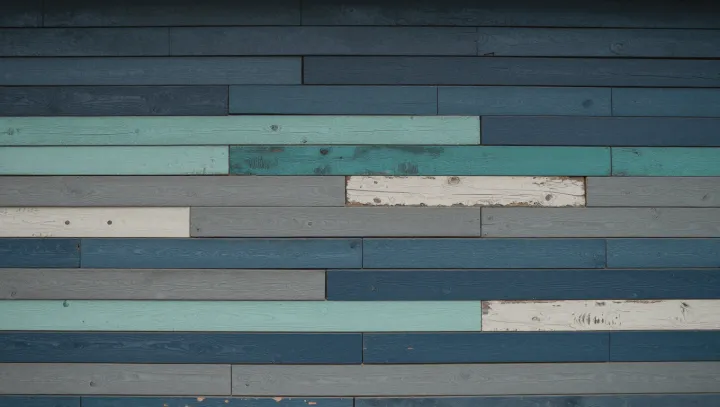
Staggered seams look stubborn. Where a wall of aligned boards presents the eye with one uninterrupted fault line, offset joints break that line, so the surface reads less like a stack of strips and more like an interlocked field. The effect is visual. Yet it borrows authority from building practice, which is why a merely decorative arrangement can seem to possess hidden muscle.
The eye cheats. Gestalt grouping and the law of good continuation make long, repeated vertical seams conspicuous; they gather into columns that resemble a crack, a hinge line, or a point where the surface might fold. The cue is immediate. A running-bond layout denies that easy reading, dispersing joint endpoints and shifting visual weight laterally as attention travels across the face rather than climbs one line. Nails barely matter. This shortcut operates before a viewer inventories adhesive, fasteners, or the wall behind the boards. That feels safer.
Physics lends an alibi. In timber assemblies and masonry, staggered joints may interrupt a continuous weakness and redistribute load paths, although fastening, substrate, and connection design determine actual shear resistance. Looks are not loads. Decorative planks gain no added resistance simply by appearing offset, yet the brain imports that construction rule into rapid structural inference: broken seams suggest redundancy, while aligned seams suggest failure waiting for permission. Perception supplies the bracing. A seam denied its straight ascent becomes, for the eye, a wall that refuses to split.