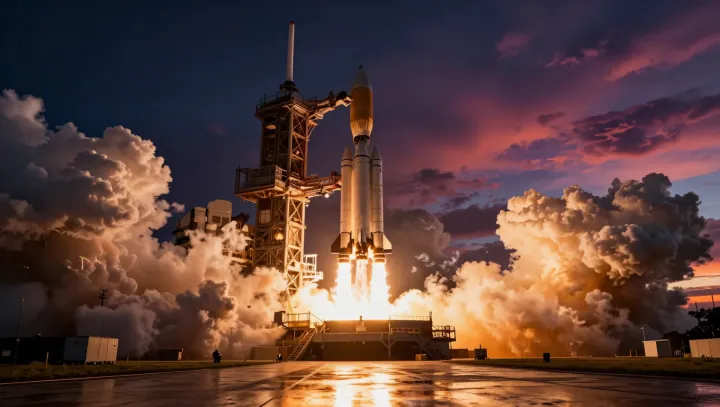
13 tonnes per second is not a flourish of space-age rhetoric; it is the entry fee a Saturn V-class launcher pays before ascent can become escape. Gravity collects first. At liftoff, the vehicle's mass flow rate had to feed five F-1 engines fast enough to push its thrust-to-weight ratio above one.
The violence of the number is the point. A rocket does not rise because its engines are strong in the abstract; it rises only when thrust exceeds weight, while its tanks shed mass and velocity begins to purchase time against gravity. No gentle departure. The Saturn V used RP-1 and liquid oxygen in its first stage, where turbopumps drove propellants through F-1 combustion chambers at rates that made the launch pad resemble an industrial furnace turned inside out. The arithmetic bites. Much of the opening minutes went not toward a destination but toward gravitational losses and atmospheric drag, two taxes levied before orbital mechanics permits a clean bargain. Payload sat at the far end of that bargain. Each added kilogram demanded more propellant, yet more propellant enlarged the vehicle, creating the tyranny described by the rocket equation. There is none. As tanks drained, staging discarded dead structure and the vehicle converted chemical energy into the delta-v required for orbit. Above the flame's ledger, Earth simply kept its hand on the departing machine.