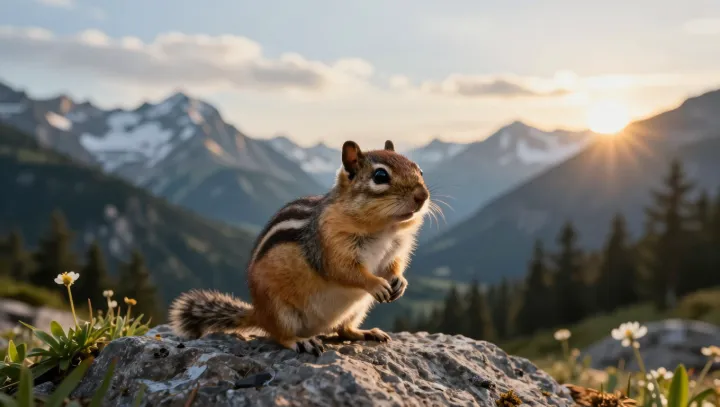
Cute is the wrong verdict. An alpine chipmunk that rises on its hind legs may be buying information, not posing: its head turns, ears test the air, and its eyes sweep nearby cover before it returns to seeds. Rarely is a pause so easily misread; under predation risk, seconds spent still can protect the animal's chance to feed again.
Food is half the job. For a small squirrel relative, foraging is governed by a risk-sensitive budget: each exposed moment may raise caloric gain while also increasing the odds that a predator detects movement. The rest is staying alive. Vigilance interrupts handling and intake, yet sensory sampling can lower uncertainty about an approaching threat, allowing the animal to decide whether to freeze, flee, or resume feeding. That tradeoff matters. Behavioral ecologists often frame it through optimal foraging theory and giving-up density, measures that treat an untouched food patch not as failure but as the price of perceived danger.
The upright stance deserves less sentiment and more respect. It is a small act of surveillance, shaped by costs that do not show in a postcard: reduced feeding time, exposure during scanning, and the limited attention available to a prey animal. Stillness can be work. Against stone and grass, the raised body becomes a question held in the air: whether the next mouthful is worth the next look.