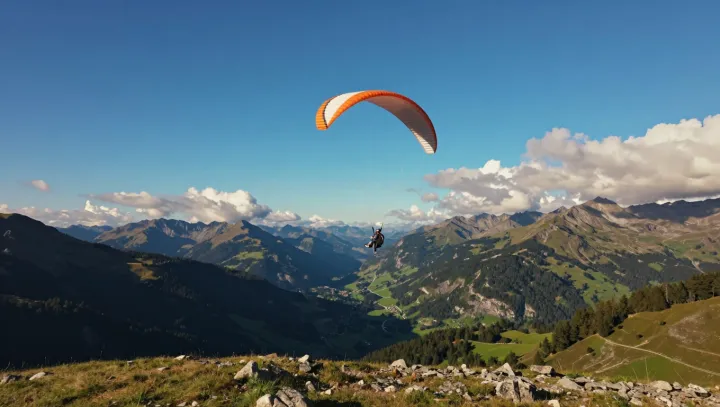
Sunlight strikes a dark field, and the air over it begins an invisible ascent. That is the bargain. A paraglider, carrying no engine, can turn uneven heating into height by circling within a thermal, the rising parcel formed when ground-warmed air becomes less dense than the air surrounding it.
The trick is less heroic than it appears. Convection supplies the lift, but it is patchy: a thermal has a stronger core and weaker, often sinking, air near its margins. Pilots search for that core with a variometer, then bank into a tight spiral, trading forward progress for repeated passage through the most energetic lift. Miss it, and descent resumes.
The bill is written in physics. As a parcel rises, lower pressure makes it expand and cool through adiabatic cooling; its advantage lasts only while it remains warmer, and therefore more buoyant, than adjacent air. The environmental lapse rate helps decide that contest. A wing's glide polar determines how much height is spent between thermals. Above the field, no engine speaks, yet the afternoon keeps its own account.