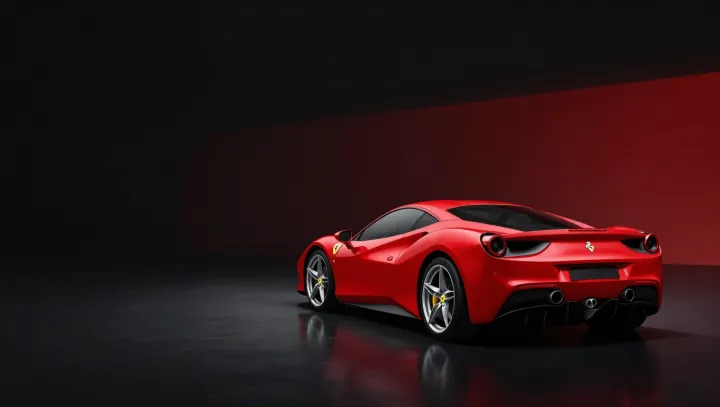
3.9-liter displacement was Ferrari's bet against the old idea that horsepower must arrive with more cylinders or volume. Pressure changed the arithmetic. Two twin-scroll turbochargers used exhaust pulses to spin turbines, forcing denser air through intercoolers and into the V8, where direct injection could add fuel with precise control. More oxygen, more burn. That raised effective cylinder filling without enlarging the block.
The cleverness lay in restraint. Turbocharging usually buys power at the cost of lag, yet Ferrari reduced compressor inertia with ball-bearing cartridges and paired turbine housings with pulse-separated scrolls, so exhaust energy arrived in cleaner, faster packets. Response stayed sharp. Variable torque management then shaped delivery through the gears, limiting low-rpm torque where traction and driveline load mattered, while allowing the engine to approach 760 Nm as speed built. That was disciplined force. The engine therefore earned its headline number across a usable rev range rather than in one theatrical spike.
The payoff was unusually complete. At roughly 172 hp per liter, the 488's output was not merely a peak-number trick: its combustion, airflow, and boost control turned a compact V8 into a broad-band power source. Heat was the tax. That required tight thermal management, because elevated boost pressure raises intake temperature and encourages pre-ignition before a piston can exploit the added charge. Cooling bought headroom. Intercooling, oil and water circuits, and calibrated exhaust flow kept charge temperatures and knock in check under sustained load. Physics, briefly, seemed persuadable.