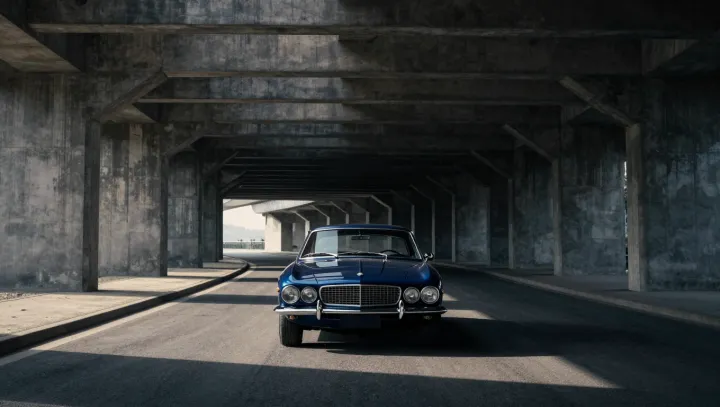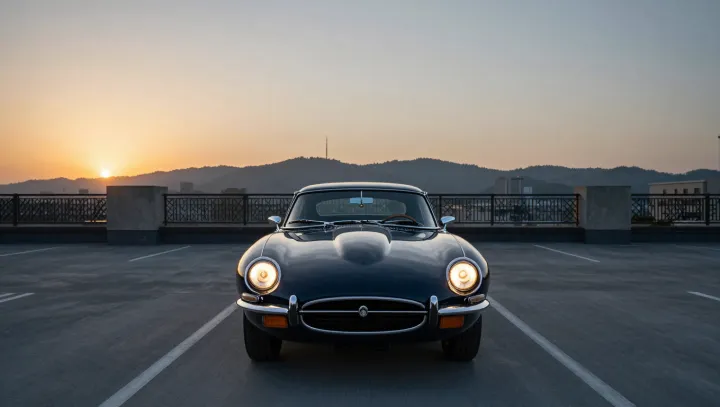
Sunset is the car's best designer. As luminance falls, a decades-old sports car keeps its argument while fussy newer shapes lose theirs: the low roofline, extended hood, and clean flanks remain readable because their massing is resolved before the eye can chase small detail.
This is less nostalgia than optical triage. Detail dies first. During luminance adaptation, color discrimination weakens, while contrast sensitivity shifts attention toward broad boundaries and strong changes in spatial frequency. A long hood gives the eye one unbroken direction; a rear-set cabin creates a second, compact mass behind it. The body reads fast. Even in near-darkness, the silhouette supplies enough visual information to identify proportion, stance, and intent without the distraction of vents, creases, or ornamental geometry.
Simplicity is not emptiness. Under grazing light, broad panels turn specular reflection into a controlled signal, with highlights sliding across surfaces rather than shattering into noise. It works like a low-bandwidth codec: signal detection theory explains why the eye retains the large, high-contrast forms when fine data disappears. The bolder wager is that cars built for mixed human and machine vision will return to this discipline. Sensors and tired eyes alike favor contours that survive compression, glare, and darkness. The future may look advanced by remembering what light refuses to erase.