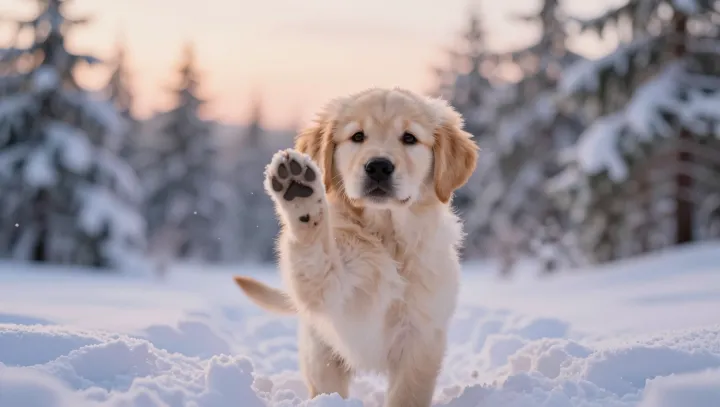
A small paw hovers above unmarked snow, and the image feels less like an animal caught midstep than a greeting offered across a threshold. That reaction is disarmingly fast. It arrives before judgment. Against a pale, quiet field, the lifted limb resembles a stripped-down social gesture: notice me, but do not fear me.
The effect is not childish projection; it is efficient perception. Social cognition favors cues that can be decoded with little effort, especially when anthropomorphism turns an animal posture into something almost conversational. A raised paw suggests pause, attention, and controlled intent. Those are legible signs. Such compression is the point: one pose packages a social hypothesis before conscious interpretation catches up. Snow removes clutter, while the absence of visible danger lowers threat appraisal, leaving the brain free to assign friendliness rather than scan for risk.
Context does much of the persuasion. In a busier scene, the same posture might signal uncertainty, injury, or alertness; in snow, its ambiguity is softened by stillness and low sensory load. The setting also encourages a low-arousal reading, because the frame offers few competing demands on attention. The amygdala is tuned to rapid relevance detection, not to poetic meaning. Yet perception supplies the poetry anyway. A paw held above white ground becomes an invitation, and the invitation works because it asks almost nothing of us. That is a modest trick of visual processing, but it carries the force of hospitality.