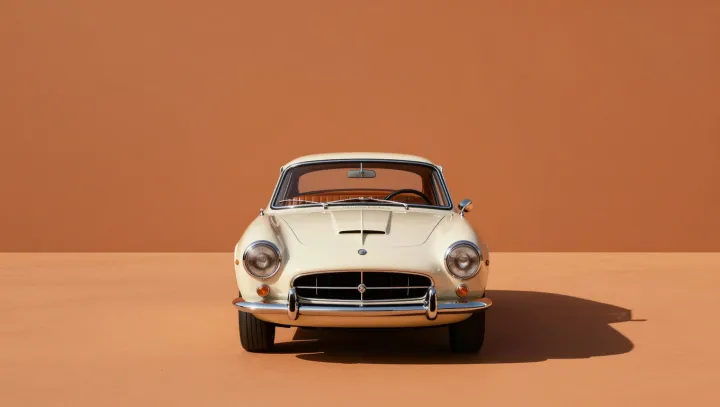
The grille sits squarely in frame, and the old coupe suddenly stops performing. It asks for nothing. A centered view turns bilateral symmetry into the main event: lamps, fenders, windshield, and bumper resolve along one axis, so the eye reads order before it begins hunting for detail.
Drama is often less satisfying. A low three-quarter angle can enlarge a wheel, stretch a hood, and hide one side of the body; that distortion creates visual tension, even when it sells speed. In frontal alignment, perspective compression is shared evenly across both halves. The car feels settled. Its age becomes proportion rather than theater.
The deeper effect is neurological, not merely nostalgic. Predictive coding rewards scenes that match stable expectations, while visual processing spends less effort reconciling competing cues from unequal surfaces. Nothing appears to be lunging. Nothing needs correction. A decades-old coupe, viewed head-on, becomes a small argument for balance: machinery made quiet by being seen whole.