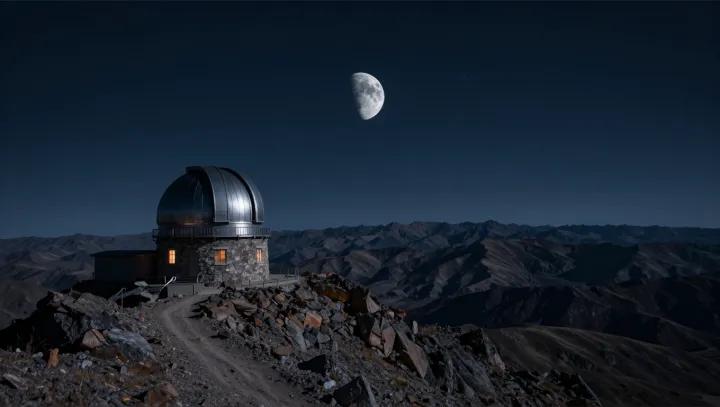
Appearance is a trick. The crescent Moon, suspended above an observatory dome, seems near enough for a hand, although its angular diameter is an effect of geometry rather than proximity; beneath it, instruments admit photons whose journeys began millions of years before the detector converted them into charge.
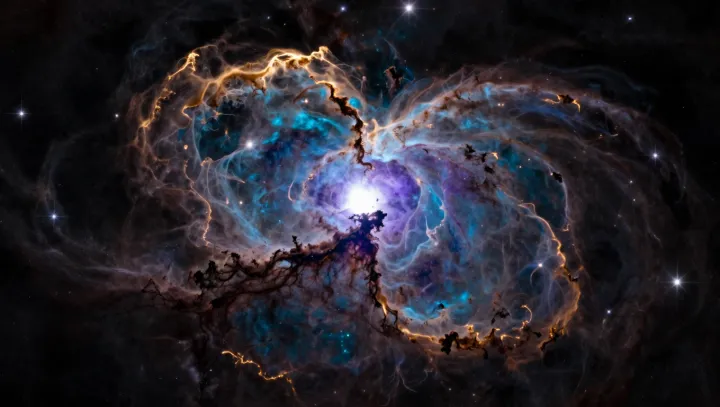
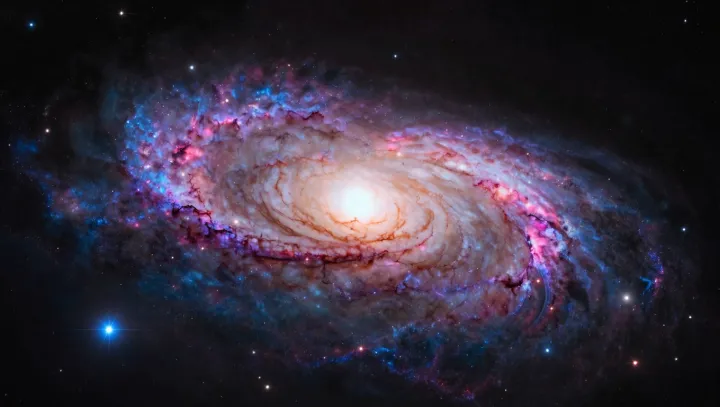
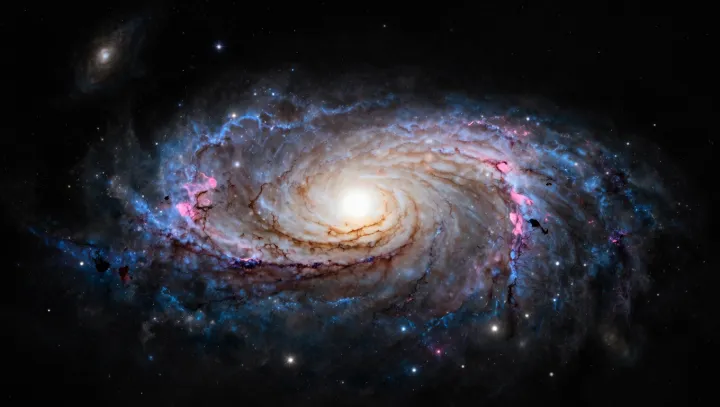
That contrast is drama. A telescope does not defeat distance; it bargains with it, using aperture to gather a thin photon flux from stars and galaxies whose light has crossed cold interstellar space, while the Moon merely occupies the familiar foreground. The math stays merciless. Spectroscopy separates that arriving light into wavelengths, and redshift can show how motion and expansion altered the signal before it reached the observatory.
The Moon wins attention. Its bright curve gives the eye an easy measure of night, yet the faint traces recorded below demand calibration, exposure control, and patient subtraction of atmospheric noise before they can become evidence. The detector refuses distraction. In that small interval between silver moonlight and distant radiation lies astronomy's oddest intimacy: what looks closest may reveal the least, while what cannot be seen plainly carries the longer story.