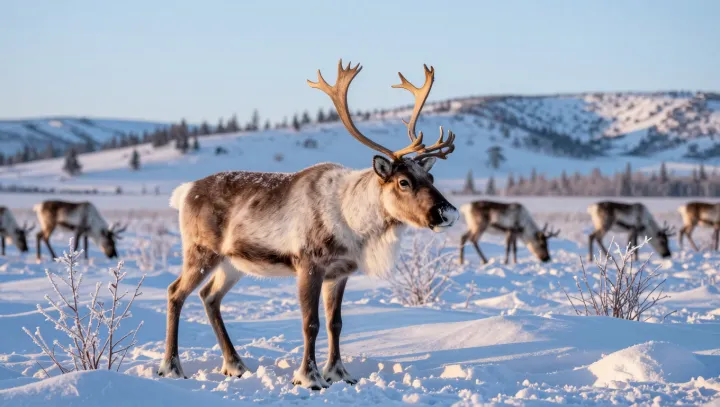
Those antlers are a winter ledger. Rising above a reindeer's head, their span advertises not ornament but a capacity to impose costs when snow seals forage beneath its crust; at feeding craters, rivals can assess size before a shove is spent. Hunger makes the arithmetic plain.
Postcards get it backward. Food, not vanity, sits at the center of the contest, because winter grazing often demands cratering through snow to reach lichens and other forage, while a dominant animal can displace a weaker one from a productive patch. That economy can spare both animals a bruising fight. This is intrasexual competition. Antlers serve as a visual cue of resource-holding potential, then as weapons during agonistic interactions when that cue fails.
The costly part matters most. Antler growth depends on osteogenesis and draws energy and minerals that cannot be spent elsewhere, so an oversized rack may carry credible information about condition rather than mere decoration. Signals that are cheap invite bluffing. Signals with biological costs can stabilize a dominance hierarchy, reducing needless fights even as they sharpen the struggle over winter food. That bargain is harsh: one animal's access may mean another leaves the crater to search harder ground, where the energy bill rises just when reserves are thin. Under snow, status becomes calories.