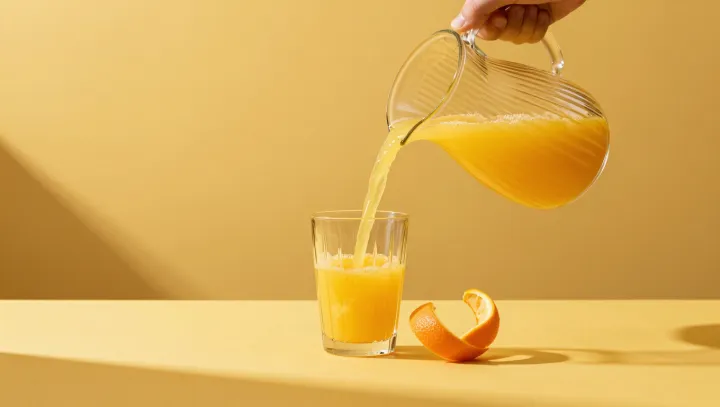
A ribbed tumbler catches low sunlight, and ordinary orange juice abruptly stops being breakfast: each vertical flute bends incoming rays through refraction, laying bright bars beside dark ones while the liquid keeps a dense field of color. The effect is theatrical. Not taste but geometry starts the drama.
The glass does most of the cheating. Its grooves act less like decoration than a bank of cylindrical lenses; as the viewing angle shifts, specular reflection flashes along some ridges while neighboring channels turn dim, producing local luminance contrast that a smooth vessel tends to erase. No filter required. At each boundary, the eye reads an abrupt change in brightness as an edge, which gives a simple drink graphic discipline. Within the liquid, suspended pulp and carotenoid pigments scatter and absorb light, preserving an opaque orange body instead of a clear, jewel-like transmission. A pale tabletop becomes a foil and presses the vessel's dark contours forward.
Shadows supply the verdict. When sunlight arrives at a shallow angle, the glass throws an extended silhouette whose boundary behaves like a chosen compositional line, separating illumination from shade with little mercy. The bright juice then takes on the gravity of paint. Nothing has been altered, strictly speaking. Yet optics has edited the scene: a domestic pour, held between glare and absence, makes abundance seem most persuasive when part of it slips from view.