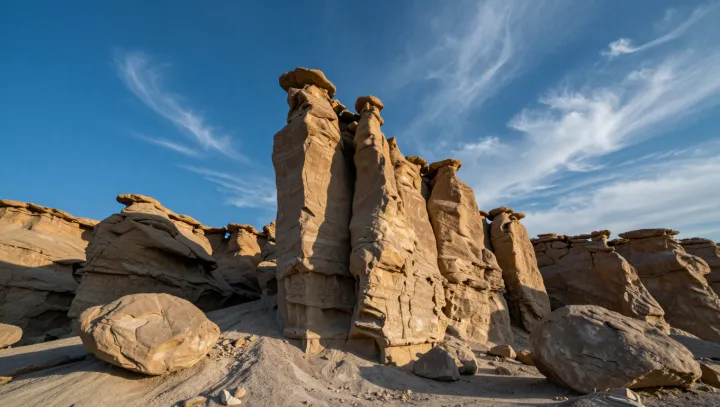
The apparent permanence is a trick. Under hard noon light, a spire can seem to have outlasted every force around it, yet its exposed face is already taking damage: wind drives quartz grains against the rock while brief sheets of water enter seams and leave mineral fragments behind.
Erosion is not gentle. Aeolian abrasion works as a slow sandblaster, most fiercely where loose sediment is available, while fluvial incision cuts channels when runoff gathers enough force to move particles. Freeze-thaw weathering can widen joints: water enters fractures, freezes, expands, and pries grains apart. Differential weathering then does the editing. Layers with weaker cement erode faster than resistant beds, so columns narrow, caps survive, and alcoves deepen. No single storm authors the form. Repetition does.
Patience wins here. The spire is less a monument than a ledger of losses, recording each grain removed and each ledge spared. Gravity completes the work when weakened blocks fall from the face. Its silhouette holds only because destruction proceeds unevenly; when that arithmetic changes, apparent permanence collapses into debris. Stone keeps no pose forever.