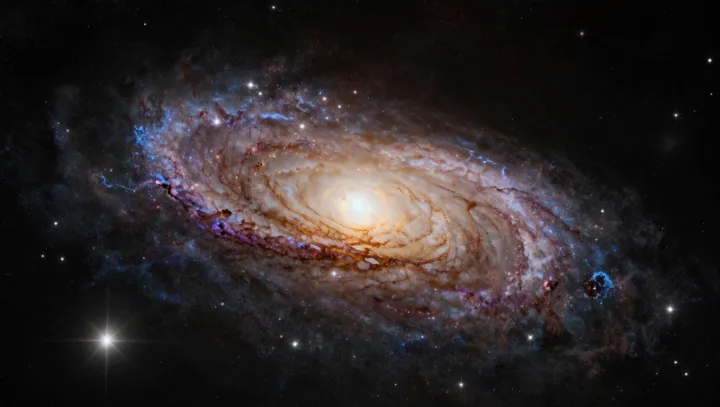
Blue knots flare. Less a portrait than an alibi, a spiral galaxy exposes its recent activity through light dominated by short-lived, massive stars: where blue clusters gather, cold molecular gas has collapsed and new suns are emerging, while the disk's yellow and red glow belongs chiefly to longer-lived populations. Age leaves color.
Dust lies well. Across a spiral arm, dark lanes can sit upstream of blue clusters, because gravitational compression in a density wave gathers interstellar gas before it forms stars; the resulting offset between extinction-heavy dust and H II regions converts a frozen image into a sequence of cause and effect. The order matters. It distinguishes an arm actively processing gas from one whose visible structure is largely the afterimage of older stars, though bars, encounters, and local turbulence can scramble the pattern.
Color can mislead. A red patch may contain old stars, yet it may also hide young ones behind extinction, so astronomers compare optical colors with infrared emission, ultraviolet light, and spectral lines such as hydrogen-alpha to estimate star-formation rates and stellar ages. No single band settles it. Read together, these traces show whether a galaxy is consuming its gas steadily, reigniting after disturbance, or slipping toward quiescence. From afar, its history is written in what dust conceals and what blue light refuses to hide.