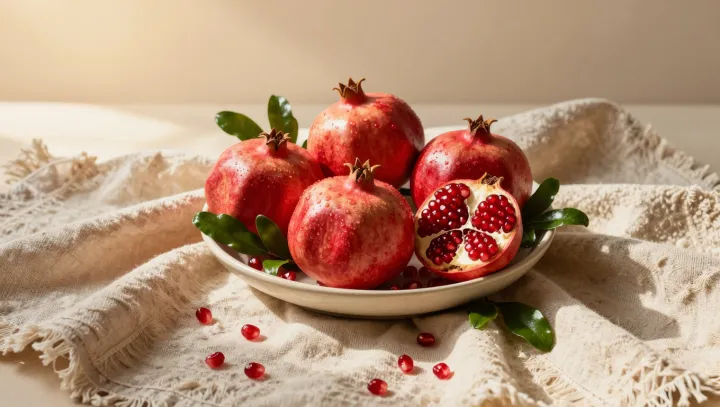
The fruit arrives sculpted. Its leathery pericarp holds a near-spherical mass in a firm contour, so the unopened pomegranate reads less like produce than an object made to command a table. Then it flashes. Once cut, hundreds of arils interrupt that restraint, catching light through watery tissue and turning one red fruit into a clustered display. Its calyx crown sharpens the profile.
The visual trick is biochemical. Anthocyanins, water-soluble flavonoid pigments concentrated in the arils, absorb portions of visible light; their red appearance shifts with pigment concentration, acidity, and the path light takes through each juice-filled sac. Think pixel array. Each aril, surrounding a seed and bounded by thin membranes, behaves like a biological display element: not a light source, but a translucent unit that reflects, refracts, and scatters it. Illumination changes the effect.
The rind deserves equal credit. Its thick outer layers provide mechanical protection and a clean visual boundary, while internal septa arrange arils in chambers rather than leaving them as a loose spill of pulp. Form meets optics. The contrast is the point: an architectural shell contains a wet, optically active field, and neither half can deliver the effect alone. Future biomimetic packaging might pair protective shells with light-responsive interiors, borrowing the principle without pretending that fruit is hardware. That is a useful provocation.