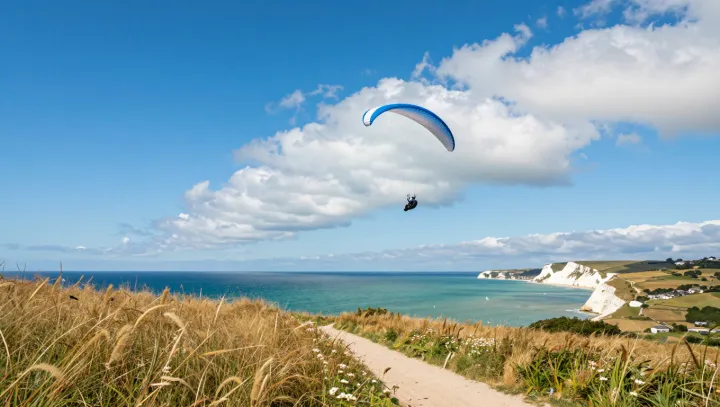
The apparent magic is blunt physics: salt air strikes a coastal cliff, and a fabric wing rises because the rock redirects an oncoming breeze into a vertical current. That is the whole trick. Near the slope, air cannot pass through stone, so it is deflected upward; a glider entering that column can trade forward speed for height.
The cliff, not the pilot, does the heavy lifting. Once airflow climbs the face, the wing needs a positive angle of attack, which creates a pressure difference between its curved upper surface and lower surface, producing aerodynamic lift. Keep it clean. If the pilot turns too far from the ridge, or lets the wing slow toward stall speed, the lift-to-drag ratio worsens and the climb ends. Skilled soaring pilots therefore fly parallel to the cliff, staying within the narrow band where ridge lift is strongest. Outside it, descending air can erase height quickly.
It is a negotiation. The wind must arrive with enough speed and a direction that meets the cliff, while turbulence behind the crest can punish a wing that drifts into rotor. No motor rescues bad air. The fabric wing climbs only while gravity's downward pull is offset by upward-moving air, a quiet bargain written along the rock face. Above the cliff, cloth and wind briefly agree on who will carry whom.