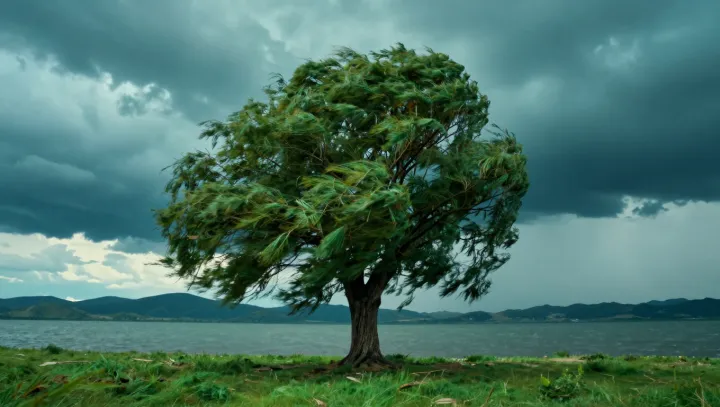
Violence is the wrong reading. At the lake edge, a lone trunk can bow until its crown seems ready to touch the water, while gusts turn branches into levers and load the base. It is not fragile. The motion is a controlled response to force, not a preview of collapse.
Flexibility wins here. Cellulose microfibrils provide tensile strength, while lignin supplies compressive rigidity; together they allow viscoelastic deformation, dispersing a gust's energy through bending rather than concentrating it at one fatal crack. Think of a mast. That comparison has limits, but branch architecture, fiber angle, and cambial growth redistribute stress as loads change. Growth remembers pressure. Repeated loading can trigger thigmomorphogenesis, which alters growth patterns over time.
Roots settle the contest. Deep anchoring roots resist overturning, while root-soil interaction transfers torque across a wider volume of ground and shares the burden below the surface. The lake exposes this. A solitary tree lacks the wind buffering offered by nearby trunks, making its foundation and flexible stem more consequential. No magic is involved. If engineers borrow this approach for adaptive structures, wind may become useful data, telling a structure when to yield, hold, and recover.