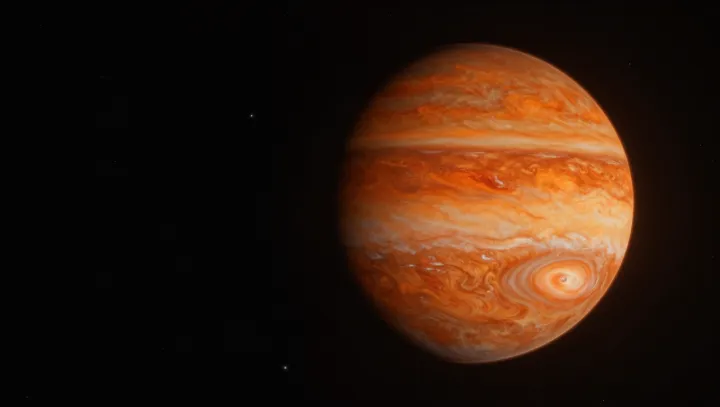
Darkness is misleading. A brown dwarf can spread across roughly Jupiter's width while withholding nearly all visible light, because its interior never sustains hydrogen fusion; instead, residual heat escapes as infrared radiation, a spectral signature that converts an apparently vacant patch of sky into a detectable cooling body. Infrared detectors, tuned to thermal emission rather than visible luminosity, can find it.
That mismatch matters. Size, which public instinct treats as a proxy for stellar status, misleads: a brown dwarf sits between planet and star, yet its defining physics is mass, gravity, and a core unable to maintain proton-proton fusion, even when its radius invites the comparison. Mass is the verdict. Unlike a star, it lacks a stable fusion-powered luminosity; gravitational contraction and stored internal energy feed its output without replenishment through sustained nuclear reactions. Visible light fails. Infrared surveys exploit thermal emission, tracing photons from cooling photospheres, while molecular absorption features act as chemical fingerprints that help separate such objects from stars and planets. Cooling sets the tempo. As internal heat drains away, luminosity declines, pushing the object farther from optical catalogs even when its bulk remains near Jupiter's scale. That is the irony. An object nearly Jupiter-sized can escape an optical census, then announce itself by warmth it cannot keep; at the detector, absence becomes evidence, and the dark sky acquires a quiet, unresolved argument.