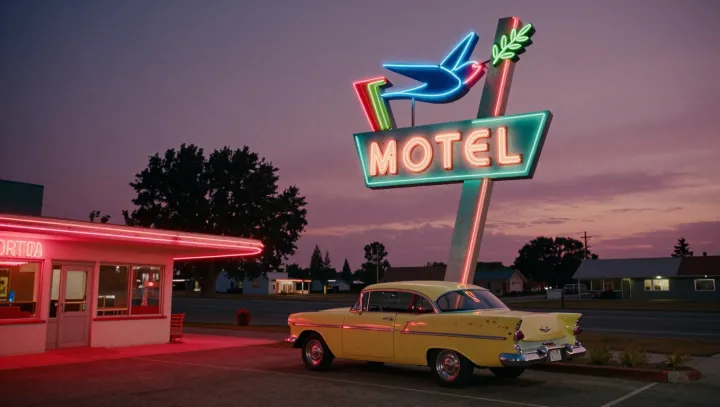
Twilight flatters old motels. Before a tube of neon hums, the sky turns blue and brick, stucco, and window glass catch the last amber light; against that cooling field, the building reads less as a tired roadside asset than as a small refuge. Not the sign, but contrast, starts the sales pitch.
The effect is mostly optical. As daylight thins, the eye weighs amber porch lamps, painted trim, and masonry against a sky with a higher correlated color temperature; simultaneous contrast makes warm tones appear fuller than they would at noon. The Purkinje shift joins in. At low illumination, blue-green wavelengths gain perceptual force, so cooling surroundings push the remaining yellows and reds forward.
Memory finishes the job. Twilight removes evidence with ruthless efficiency: cracked asphalt, faded curtains, and empty lots lose edge definition, while a low roofline and lit office window begin to resemble an invitation rather than an inventory problem. Arrival was the original promise. Roadside architecture addressed the moving driver, who needed legibility from a car and reassurance before sleep; at dusk, visual noise recedes and that commercial purpose becomes intimate. The neon has not spoken, yet the road already feels farther away.