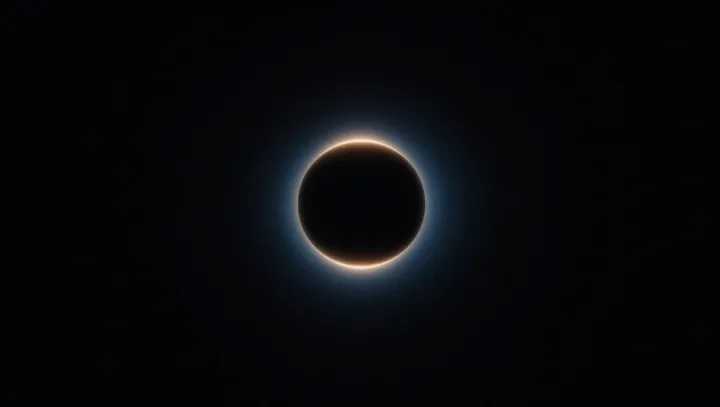
Darkness does not win. When Titan lies between a camera and the Sun, sunlight scattered through the margins of its atmosphere can trace a luminous outline around a disk whose visible surface receives little direct illumination. The ring is atmospheric. What appears to be an illuminated boundary is light redirected by suspended haze particles, not a separate ring encircling Saturn's largest moon.
Geometry does the work. Especially effective at small scattering angles, forward scattering sends sunlight roughly along its original direction, allowing an observer looking toward the Sun past Titan to detect haze around the moon's edge. The surface stays hidden. Along that edge, called the limb, the viewing path crosses an extended stretch of atmosphere, where many particles contribute to the light recorded by a camera. Chemistry supplies the particles. Titan's nitrogen-rich atmosphere contains methane, which sunlight helps transform into complex organic compounds that form photochemical aerosols and obscure the ground beneath them.
The outline rewards scrutiny. Rather than treating the glow as decoration, researchers can examine its brightness and distribution, which carry information about the abundance, size, and vertical arrangement of atmospheric particles. Interpretation demands some restraint. A photograph alone cannot settle those properties, because wavelength, viewing geometry, and the way particles scatter light all influence what reaches the detector. Darkness becomes a probe. By comparing observations with radiative transfer models, scientists can test explanations for the haze without mistaking an optical effect for emission from the moon itself. Around an unseen world, borrowed sunlight draws the boundary.