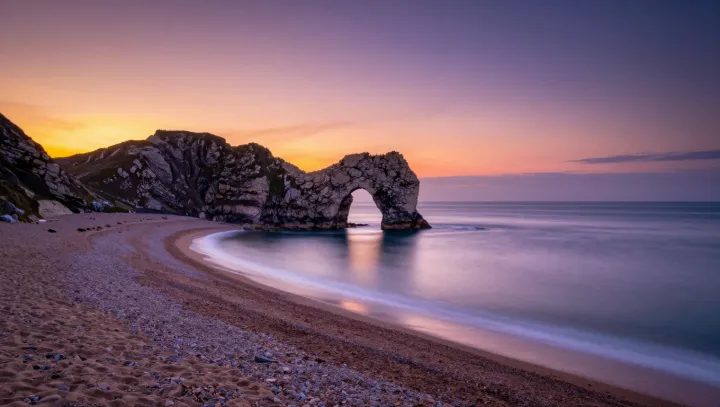
Resistance is not immunity. Durdle Door's limestone arch remains because the sea eroded its fractured sections while removing the less resistant rocks behind it, rather than wearing every layer away at the same rate. Hardness alone explains little. The result reflects differential erosion, in which rock strength, fractures and exposure determine what disappears and what survives.
Weakness dictated the opening. Along this stretch of Dorset's coast, a resistant band of Portland limestone stands seaward of softer rocks, including clays and sands, which became easier targets once waves breached the outer barrier. Water exploited existing fractures. Through hydraulic action, breaking waves force water and compressed air into cracks, helping loosen blocks even where the surrounding limestone remains resistant. Debris supplied the tools. Stones driven against the rock produce abrasion, enlarging the breach while wave attack and weathering remove weaker material farther inland, leaving the surviving limestone conspicuous against the excavated space behind it.
Survival is only temporary. The arch persists because enough limestone remains above and beside the opening to support its own weight, not because seawater somehow stopped attacking it after reaching the softer beds. Structure sets the limit. Its joints, steeply tilted bedding and changing exposure govern where pieces can detach, while chemical dissolution also contributes to limestone's gradual loss without explaining the feature by itself. The roof still holds. Beneath it, each passing wave occupies a space that was once solid rock, making the arch less a victory over the sea than a pause in its removal.