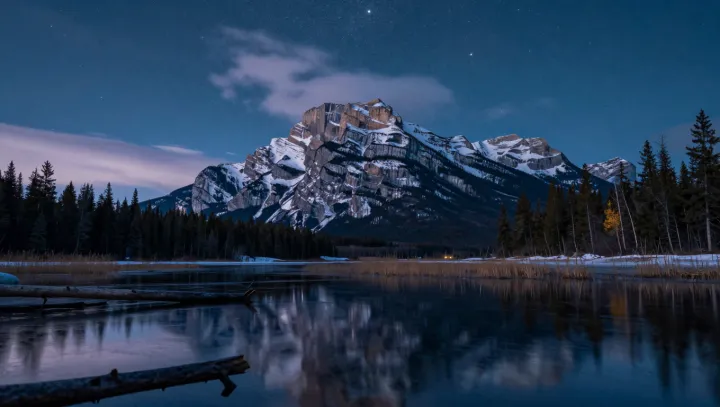
The Rockies defied proximity. Although mountain building often clusters near plate boundaries, these ranges rose hundreds of miles inland because an oceanic plate slid unusually far beneath North America before descending into the mantle. Distance offered no protection. The leading explanation is flat-slab subduction, which carried the effects of plate convergence deep beneath the continent rather than confining them to its edge.
Angle mattered more than location. Where the Farallon Plate plunged beneath North America's western margin, its shallow descent brought it into prolonged contact with the underside of the continent, allowing compression to reach regions far from the ocean trench. The crust absorbed the squeeze. During the Laramide orogeny, that compression reactivated weaknesses and drove reverse faults through ancient crystalline basement, lifting immense blocks that became mountain ranges separated by basins. These were basement uplifts. Unlike mountain belts built chiefly by folding sedimentary layers, much of the Rockies involved deformation of the continent's deeper structural foundation.
The explanation remains unfinished. Although geological evidence supports shallow subduction, researchers still debate what flattened the slab, with unusually buoyant oceanic crust among the proposed causes and variations in plate geometry complicating any single account. Today's heights complicate matters. Later uplift, erosion, and glaciation altered the ranges, so their present elevations cannot be assigned entirely to the original episode of compression that raised the basement blocks. The coast seems distant. Beneath the peaks, however, the rock preserves the pressure of an ocean floor that vanished from sight without surrendering its reach.