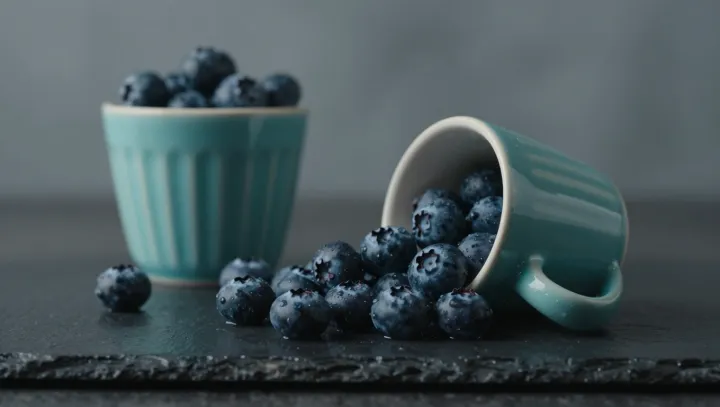
The blue is borrowed. A blueberry gets its familiar appearance from microscopic structures in its outer wax coating, which scatter incoming light rather than supply a blue dye. Pigment takes second billing. Beneath that dusty surface, anthocyanins contribute dark red and purple coloration, but they do not explain the blue that reaches an observer's eyes.
Disorder does the work. The coating, called epicuticular wax, contains tiny, irregularly arranged structures whose dimensions favor the scattering of short wavelengths, including blue and ultraviolet light, rather than reflecting all visible wavelengths equally. This is structural coloration. Unlike pigmentary coloration, which depends on molecules absorbing particular wavelengths, this effect depends on how physical structures redirect light, making the fruit's appearance a matter of geometry as well as chemistry. The distinction survives extraction. Wax removed from the fruit can reproduce the optical effect when its microscopic structure forms again, separating the source of the blue from the berry's underlying pigments.
The surface deserves credit. Rub away the waxy bloom and the fruit looks darker, because the scattering layer has been disturbed and the pigmented skin beneath becomes more apparent. Juice tells another story. Crushing a blueberry releases anthocyanins whose appearance depends partly on acidity, so the resulting liquid need not resemble the intact fruit displayed in a bowl. Appearance belongs to architecture. On an untouched berry, a nearly colorless material arranges the light into a blue that vanishes when its small structures are swept aside.