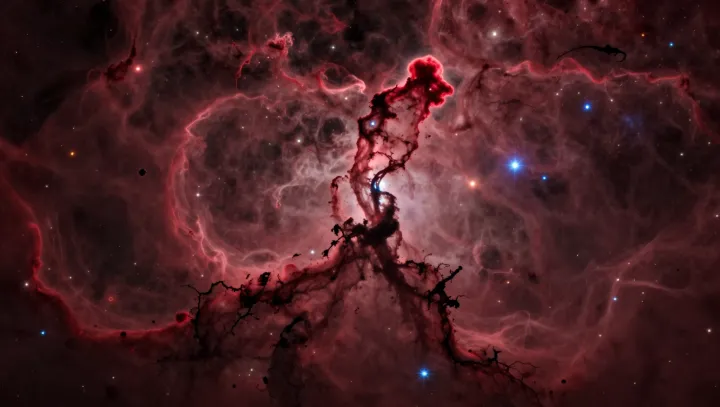
Darkness here means abundance. The Elephant's Trunk Nebula looks like a missing piece of the sky, but its silhouette comes from dense dust that absorbs and scatters visible light, hiding stars still taking shape within it. Absence is the illusion. Against the surrounding glow, the cloud advertises not an empty volume but matter thick enough to obstruct the view.
The shadow does work. Astronomers call the dimming extinction, a process in which dust grains along the line of sight prevent much of a star's visible light from reaching an observer. Hidden does not mean inactive. Inside sufficiently cold, dense pockets, gravitational collapse can draw gas inward, forming protostars whose growth continues as surrounding material falls toward them. Darkness alone proves little. A black patch is not automatically a stellar nursery, but observations of young objects within this cloud establish that its obscuring material conceals actual star formation, not merely its possibility.
The edge is contested. Located within the glowing IC 1396 region in Cepheus, the trunk faces radiation from a nearby massive star that illuminates its surface while wearing away exposed gas. Infrared changes the evidence. Because longer wavelengths generally pass through dust more readily than visible light, infrared observations can reveal embedded young stars that ordinary images leave concealed. The shelter is temporary. As radiation erodes the cloud and forming stars alter their surroundings, the same material that hid their beginnings can disperse, leaving light where an optical image once recorded a stubborn black stroke.