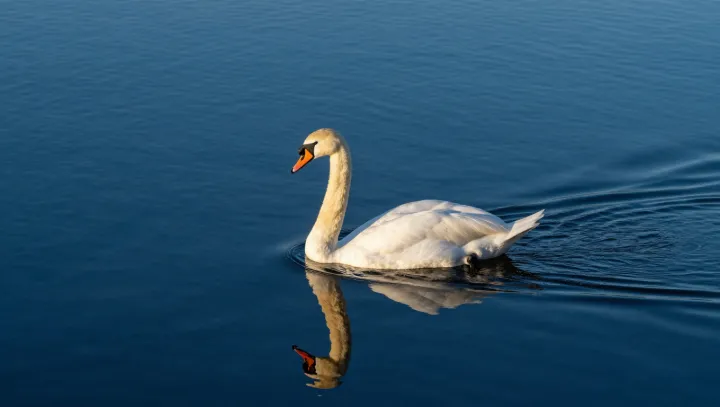
Swan necks multiply the joints. A swan can have 24 cervical vertebrae, more than three times the seven in a human neck, making its apparently seamless curve a chain of separate bones. Grace conceals considerable machinery. Beneath the feathers, that chain supplies numerous points of movement, allowing the head to change position without requiring the whole body to follow.
Length alone misses the story. Whereas a giraffe achieves its extraordinary reach with seven greatly elongated cervical vertebrae, a swan combines neck length with a much larger number of skeletal segments. The joints matter too. Avian cervical vertebrae have saddle-shaped articulations, called heterocoelous joints, whose geometry permits movement in several directions while helping adjacent bones remain securely connected. Flexibility still has limits. Muscles, ligaments and the shapes of neighboring vertebrae constrain each movement, so the familiar curve results from coordinated bending across multiple joints rather than unrestricted rotation at any single point.
Elegance earns its keep. When a swan lowers its head beneath the surface to feed, its neck extends its reach toward aquatic vegetation while the body remains afloat above. Grooming demands precision too. The same articulated structure lets the bill reach feathers across the body, where preening helps maintain the plumage on which insulation and water resistance depend. Bone counts need qualification. The exact total varies among swan species, so the comparison describes their anatomy without assigning every swan an identical skeleton. Stillness completes the illusion. Above the water, a folded neck leaves its many working joints almost entirely out of sight.