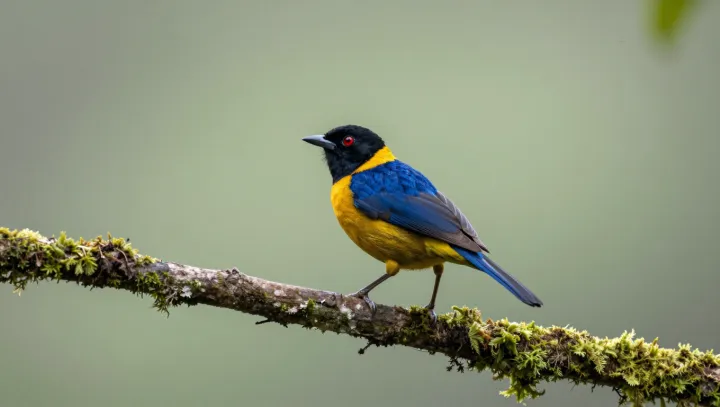
The hooded mountain tanager's blue is not necessarily a matter of blue dye. Light can make the color instead. In Andean mountain forests, the bird's black hood and red eyes frame blue-and-yellow plumage, but its blue feathers belong to a broader story about how microscopic architecture can shape what the eye sees.
The trick lies in the feather's construction, not simply its ingredients. In many birds, tiny feather branches called barbs contain a spongy arrangement of keratin and air pockets; their dimensions affect how incoming light is scattered. Blue wavelengths can be reinforced through coherent scattering, while a dark layer of melanin beneath helps absorb light that might otherwise wash out the color. Structure does the work. The exact microscopic arrangement in this tanager would require direct examination, but structural color is a well-established explanation for blue plumage in birds.
That distinction makes the bird's appearance less like a painted surface than a meeting between material and light. Pigments absorb some wavelengths and leave others to be seen; structural color depends on the scale and arrangement of physical features that interact with light. Change the structure enough, and the color can change too. The yellow feathers need not work the same way: yellow in birds often comes from carotenoid pigments, though the source in this species should not be assumed without testing. Against the mountain forest, the blue remains visible, its apparent simplicity concealing an intricate architecture.