A black hole can power a blaze brighter than a galaxy without surrendering a single ray from its interior. The distinction matters. The light comes from matter outside the event horizon, the boundary beyond which escape is impossible, not from the darkness that artists place at the center of the scene.
The real spectacle is the fall. Gas spiraling toward a black hole can form an accretion disk, where orbital motion and magnetic turbulence help matter lose energy and move inward. As the gas compresses and heats, it emits radiation across a wide range of wavelengths, including visible light and X rays. Not every disk shines equally. A well-fed supermassive black hole can power a quasar whose radiation outshines the combined starlight of its host galaxy; a black hole with little gas nearby may be far harder to see. The brightness is paid for by matter giving up gravitational energy before crossing the horizon.
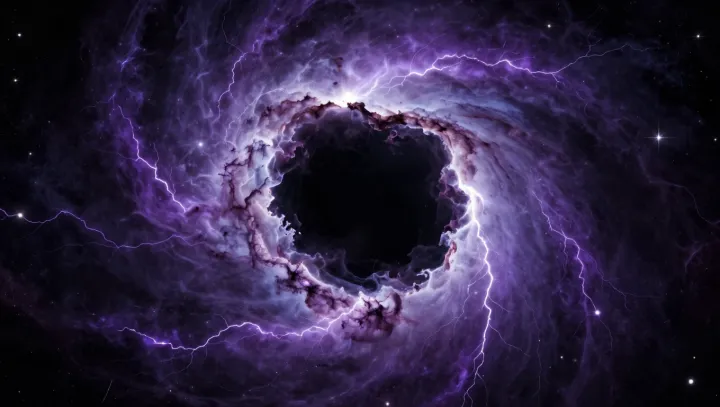
Cosmic art can mislead as much as it reveals. A glowing ring may suggest a solid surface, yet a black hole has no surface of the ordinary kind; the event horizon marks a boundary in spacetime. Light from the surrounding gas can also be bent by gravity, making the disk appear warped and producing a dark central region often called a shadow. Its exact appearance depends on the viewing angle and the properties of the emitting matter. What looks like a portrait of emptiness is, instead, a record of everything struggling toward its edge.