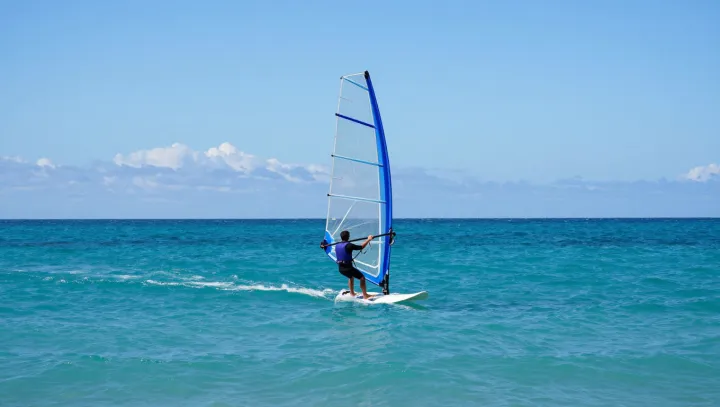
A windsurfer can outrun the wind without breaking any laws of physics. The trick is not to chase a gust straight downwind, but to travel at an angle to it. There, a sail behaves less like a sheet being pushed and more like a wing moving through air.
The sail's most useful force is lift, not a shove from behind. As the board moves, its motion combines with the true wind to create apparent wind, the airflow the sail actually feels. That airflow produces lift roughly across its direction; depending on the sail's angle, part of that force pulls the board forward. Speed changes the calculation. Faster travel alters the apparent wind, which can strengthen the airflow over the sail and help sustain speeds above the true wind speed, provided drag and course do not eat up the gain.
Water is no passive bystander. The fin, together with the board and any immersed rail, resists the sideways component of the sail's force through hydrodynamic lift and drag. Without that resistance, the board would slip sideways instead of making much headway. The wind supplies energy because air and water move relative to one another; the board and fin make use of that difference. This is not a license to sail directly downwind faster than the wind in a steady state. The faster passage lies at an angle, where air and water hold their quiet contest.