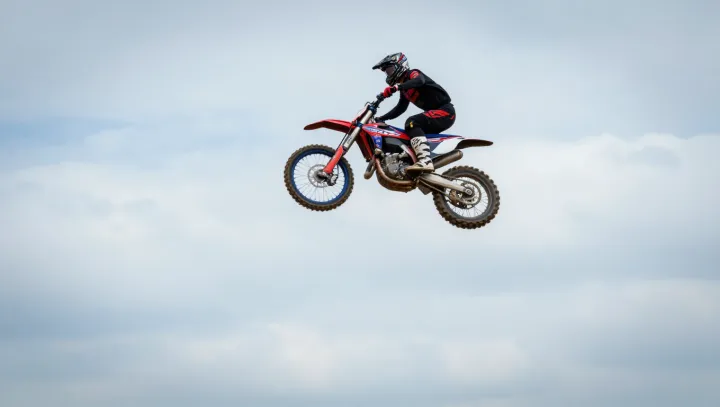
A dirt bike can tilt in midair without anything beneath it to push against. The trick is not a defiance of physics but an exchange of rotation within the airborne machine and its rider. A spinning rear wheel gives that exchange an especially useful handle. Gravity still pulls everything downward.
The wheel is a reservoir of angular momentum, not a miniature engine for changing the bike's flight path. When the throttle speeds up the rear wheel, the reaction torque tends to pitch the bike's nose upward. Apply the rear brake and the exchange reverses: as the wheel slows, the chassis tends to rotate nose down. These changes follow the conservation of angular momentum, though air resistance can exert a small external torque. The effect has limits. Wheel speed, the bike's mass distribution and the time available in the air all shape how much its angle can change.
The rider's body is another part of the bargain. Shifting position can rotate the bike relative to the rider and alter the combined system's moment of inertia, but it cannot move the pair's center of mass along a new path without an external force. Posture also affects how the rider and suspension absorb the landing. Control, then, is not the same as escape from the arc set at takeoff. For a moment, bike and rider trade motion beneath an indifferent sky.