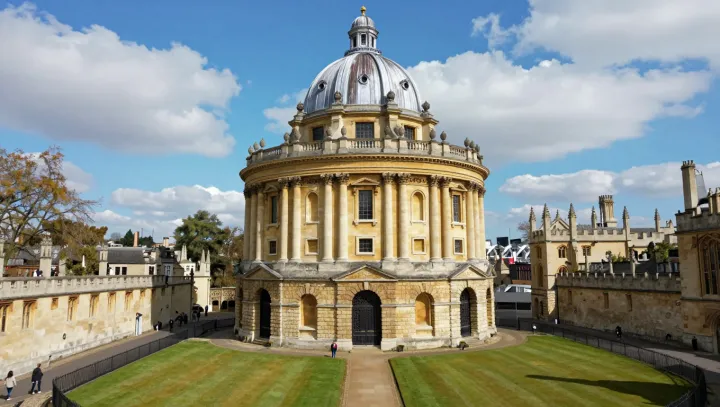
The Radcliffe Camera became more useful by surrendering its original purpose. Built with money left by physician John Radcliffe, Oxford's domed library was intended chiefly for scientific books; today it serves readers of the Bodleian Libraries, its change of function concealed by the apparent permanence of its stone exterior.
The ambition was personal, but the building was public in spirit. Radcliffe's bequest paid for a library designed by James Gibbs, whose circular plan and imposing dome gave Oxford an architectural landmark. Inside was a working collection. The Radcliffe Library acquired books on subjects including medicine and natural history, while its trustees managed an institution separate from the Bodleian. The distinction mattered: the physician's fortune had created a library with its own governance and collecting priorities, not merely an extension of an older institution.
Its absorption was a practical answer to changing scholarly needs. As scientific collections moved to the library at Oxford's University Museum, the Camera passed to the Bodleian and became a reading room, providing space for readers and books beyond the older library buildings. Its purpose widened. The Bodleian's legal deposit collections and other holdings now serve scholars across disciplines, rather than the scientific constituency envisaged for Radcliffe's foundation. Beneath the dome, a reader sits where one idea of knowledge made room for many others.